By Gallica
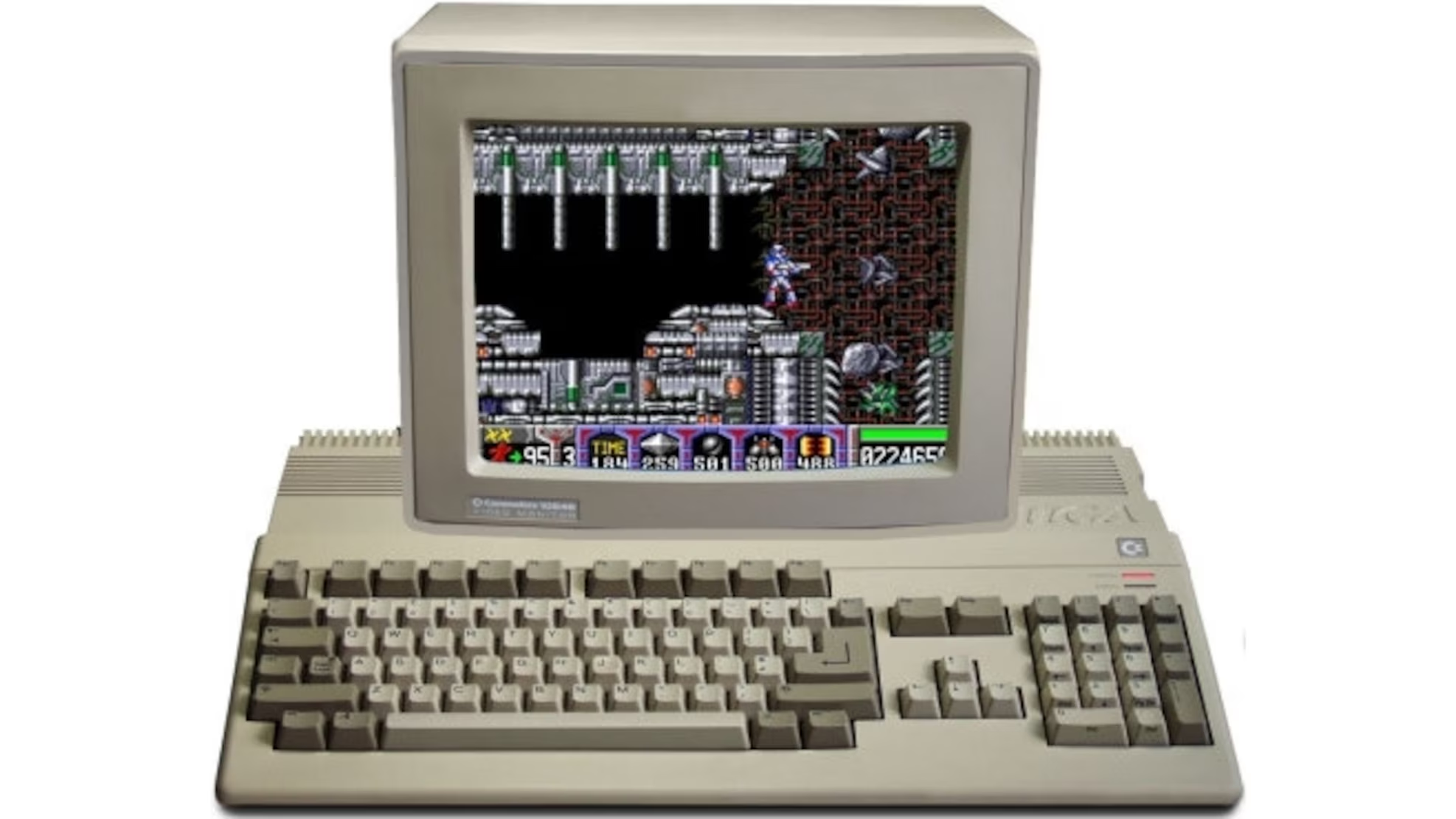
Discover why the Amiga 500 could have revolutionized video gaming, and how its immense potential remained untapped in the face of consoles like the Megadrive or the Super Nintendo.
Somaire
I. Introduction: When genius is not enough
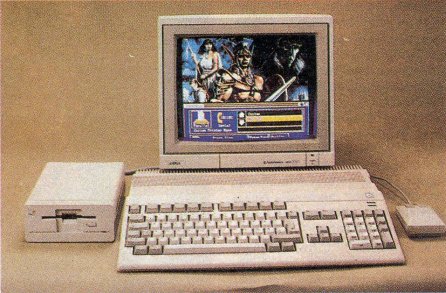
The Amiga 500 is a landmark of European microcomputing, adored by tech enthusiasts and still celebrated by the demo scene. But deep down, this machine was never the “queen” of video games as it should have been. So, why such a fate for such visionary hardware? Was the Amiga 500 just a competitor to the Atari ST or could it rival – even surpass – the legendary consoles that were the Megadrive and the Super Nintendo? This article lifts the veil on a monumental missed opportunity: that of turning the Amiga into a “console killer.”
II. What the Amiga 500 really had under the hood
- Motorola 68000 Processor (16/32 bits, 7.16 MHz), supported by three unique custom chips:
- Agnus: memory management, copper, blitter
- Denise: graphics, color management, sprites, hardware scrolling
- Paula: audio, interrupts, input-output
- Graphics:
- Standard modes: 320×256 with 32 simultaneous colors out of 4096
- HAM mode: 4096 colors on screen – a record at the time
- Copper: dynamic palette changes, split screen, advanced effects
- Dual playfield, hardware sprites (up to 8/multiplexed), hardware multidirectional scrolling
- Audio: 4 stereo PCM channels, 8 bits, up to 28 kHz, capable of orchestral music or stunning PCM effects as early as 1985
- Expandability: RAM up to 9 MB, fast expansion ports
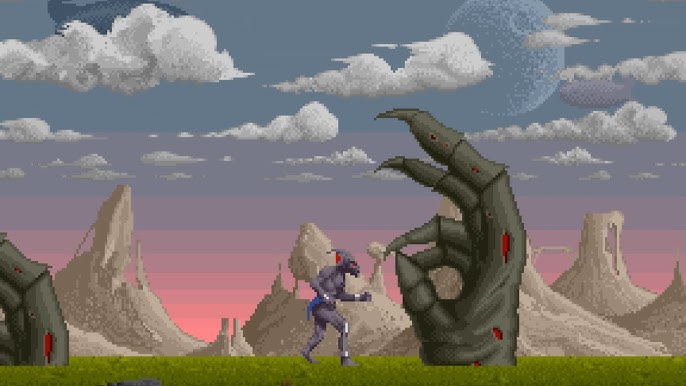
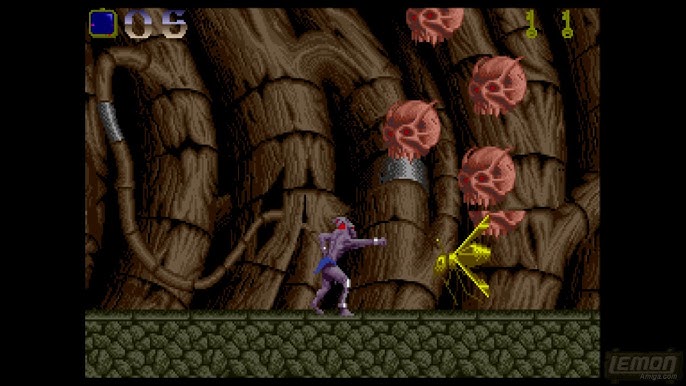
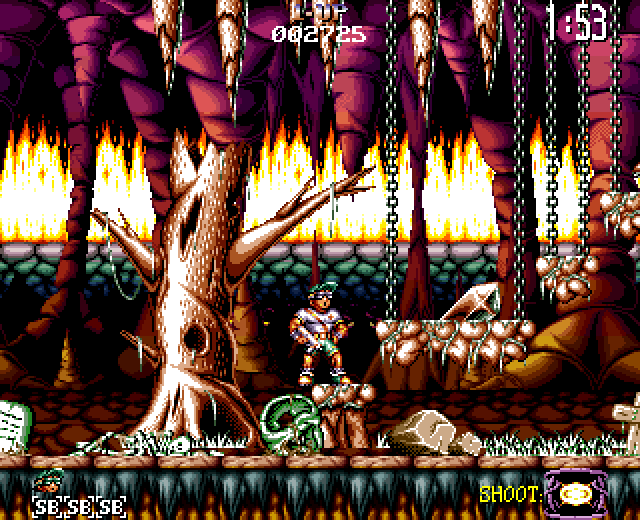
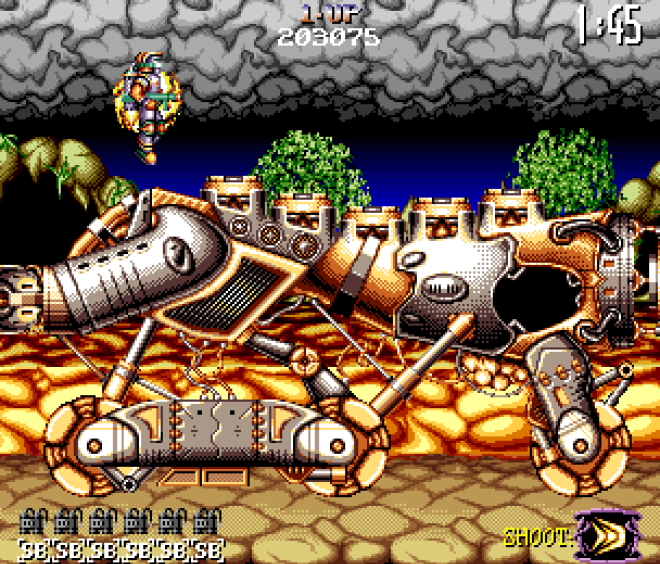
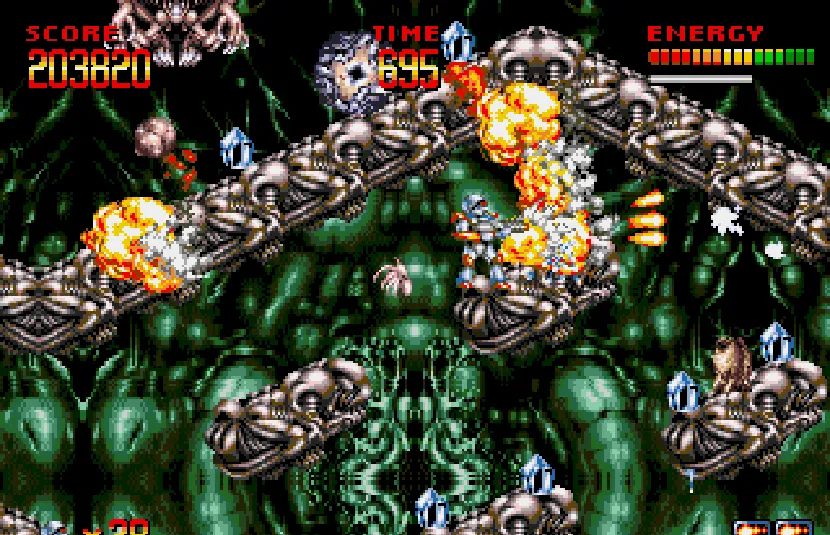
Notable examples: Shadow of the Beast (1989), Lionheart (1992), Turrican II (1991) – all push the hardware limits: gradients, parallax, “CD” music, giant sprites, copper effects… The demo scene breaks these barriers with visual shows at 256, 512, 1024 colors, light effects, real-time video (Enigma, Arte, State of the Art…).
III. Why the Amiga was underutilized
1. The curse of the Atari ST port
80% of commercial Amiga games are direct ports from the Atari ST. Programmed for the more limited machine, they do not utilize the copper, the blitter, or the Amiga’s rich sound capabilities. Result: choppy scrolling, dull graphics, basic sound. Example: Double Dragon, R-Type, OutRun: all “crippled” versions while the Amiga could offer much more, as shown by some fan hacks or demo remakes.
2. The absence of a proper SDK
Commodore never provided a “turnkey” development kit to exploit the advanced functions. Result: few studios ventured into the hardware, most settling for generic routines. Where Sega/Nintendo offered powerful SDKs, the Amiga remained a “terra incognita.” Only demomakers and a few expert studios uncovered its secrets.
3. Copper, blitter, and the myth of 32 colors
The 32-color limit is a myth. Thanks to the copper, it is possible to change the palette on each line, or even each pixel, allowing displays of 256, 512, or even 1024 colors. The demo scene and some “out-of-the-ordinary” games (Lionheart, Shadow of the Beast III, Turrican 3, Unreal) proved this, but without documentation or SDK, most titles remained limited.
4. The absence of cartridges: an industrial crime
Commodore never offered game cartridges even though the expansion port allowed it. Consequences: slow loadings, massive piracy, impossible to offer “instant games” like Megadrive/SNES. If a “load booster” cartridge had existed, games could have loaded assets and critical routines in ROM, paving the way for even more ambitious titles.
IV. What was needed: modern SDK and console ecosystem
An SDK like Scorpion Engine (2020) as early as 1990 would have allowed:
- Multiplexed sprites, copper, split palette, parallax, tracker music, complex animations
- Full exploitation of the hardware, accessible even to average studios
- Games like Worthy, Boss Machine, Inviyya show what a good tool allows even on “stock” Amiga
A cartridge format would have allowed heavier assets, more effective protections, and games with “console” comfort and smoothness.
V. Demonstration: The Amiga 500 versus a major Megadrive/SNES arcade game
Let’s take Thunder Force IV (Megadrive) or Axelay (SNES):
- Rich palette, multiple scrollings, parallax, giant sprites, lighting effects
- Rich audio, spatialization, smooth animation
On Amiga, these results are achievable thanks to:
- Copper for managing multiple palettes and sky effects
- Hardware sprite multiplexing and blitter for many objects on screen
- Dual playfield and tricks for complex scrollings
- 4-channel tracker music (mixed sample, PCM, spatialization)
- A cartridge/memory expansion to speed up loading and multiply assets
Proofs:
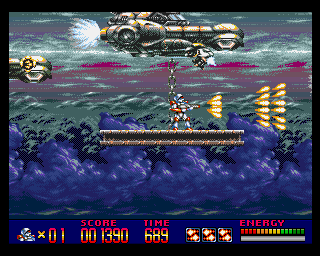
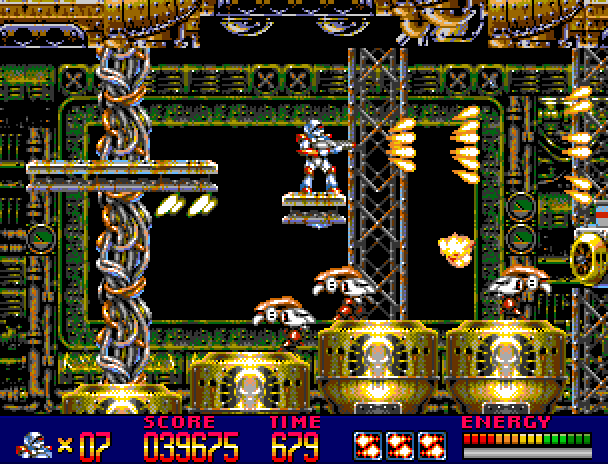
Turrican II already offers parallax, animated sprites, dynamic palette and memorable music with 512 KB of RAM!
Jim Power (multi-platform) visually competes on Amiga, despite the absence of hardware effects specific to consoles.
VI. Modern homebrew and demo scene: the potential finally unleashed
Today, homebrew and the demo scene prove that the Amiga was limited by the ecosystem, not by the hardware:
- Boss Machine (2024) surpasses all the old games on the platform
- Tools like Scorpion Engine, RedPill, modern cross-compilers: the hardware is finally democratized
- The demo scene displays 200, 400, even 1000 colors on screen with effects impossible in the commercial era
- Modern remakes (Zelda, Sonic, Super Mario) demonstrate that the Amiga can host graphic universes comparable to those of 16-bit consoles
VII. Conclusion: the sacrificed genius… but immortal
The Amiga 500 was never beaten by consoles on the hardware level, but by the absence of industrial vision and development standards.
If Commodore had chosen the “console” path – effective SDK, innovative cartridge format, valued creativity – Europe could have lived its golden age of video games before the Playstation era.
Today, the homebrew and demo scene is catching up on lost time. The Amiga 500 remains the machine of “what if…”, a legend still alive.