
| Key Points | Details to Remember |
|---|---|
| 🛡️ Definition | Residential proxy: IPs assigned to individuals for maximum anonymity. |
| ⚡ Performance | Latency and throughput vary depending on infrastructure and location. |
| 🌐 Coverage | Geographical areas covered and IP diversity are crucial for targeting. |
| 💰 Pricing | Per-minute models, pay-as-you-go or annual plans affect the budget. |
| 🔌 Integration | APIs and SDKs facilitate deployment regardless of tech stack. |
| 📊 Use Cases | Scraping, geolocated testing, multiple account management. |
In 2025, the needs for data scraping, interface testing, and geolocation push to revisit the choice of a residential proxy. Naproxy, Bright Data, and Smartproxy occupy the podium, but each presents unique strengths and limitations. For those seeking a compromise between reliability, speed, and budget, this guide details the specifics of each solution and proposes an action plan to select the most suitable option.
Somaire
What is a residential proxy and why adopt it?
Unlike datacenter proxies, a residential proxy uses IP addresses assigned to individuals. This setup allows easier bypassing of anti-bot systems and access to geo-restricted content without raising suspicion. In practice, companies use it to:
- Scrape sector-specific web pages without being blocked,
- Test an application or content from various geographic areas,
- Manage multiple accounts on social platforms.
In reality, this geographic granularity often comes at a high price. That is why we compare here three major players, each having shaped its offer around different volumes, pricing, and value-added services.
Presentation of the players
Naproxy
Naproxy establishes itself as an agile platform, oriented towards startups and small teams. Its strength lies in an intuitive dashboard that details usage hour by hour and offers intelligent routing to optimize the budget. The network relies on a pool of several hundred thousand IPs mainly distributed in Europe and North America.
- Pricing: monthly packages starting at $50 for 50,000 minutes,
- Rotation: automatic every 10 to 15 seconds, configurable depending on usage,
- API: REST endpoints and SDKs for Python, JavaScript, Ruby.
Despite somewhat less dense coverage in Asia, Naproxy remains an excellent starting point for those beginning with residential scraping without wanting to dissect an opaque pricing grid.
Bright Data
Bright Data, formerly Luminati, holds the most extensive residential network on the market, with several million IPs and coverage in over 195 countries. Its premium positioning is explained by:
- Advanced options: sticky IP rotation, static or routed modes,
- Marketplace: access to specific proxies (mobile, ISP, datacenter),
- Personalized support: dedicated onboarding, SLAs, and technical advisors.
This richness comes at a cost: prices often peak above $1,500 per month for a substantial pool. Yet, for very large-scale operations or ultra-precise geolocated testing, the price is justified by reliability and controlled latency.
Smartproxy
Smartproxy sits between the two above, blending a solid network with a more affordable pricing policy. With over 40 million IPs and presence in 195 countries, the offer includes:
- Pay as you go: billing per byte or per gigabyte (starting at $12.5/GB),
- Turnkey versions: Chrome Extension, WordPress Plugin,
- Flexibility: possibility to mix residential and datacenter proxies.
The clear documentation and video tutorials are appreciated, ideal for teams without strong network expertise. If your usage combines scraping and web rendering tests, Smartproxy offers a good balance between performance and cost.
Criteria for selecting a proxy in 2025
1. Pricing and consumption model
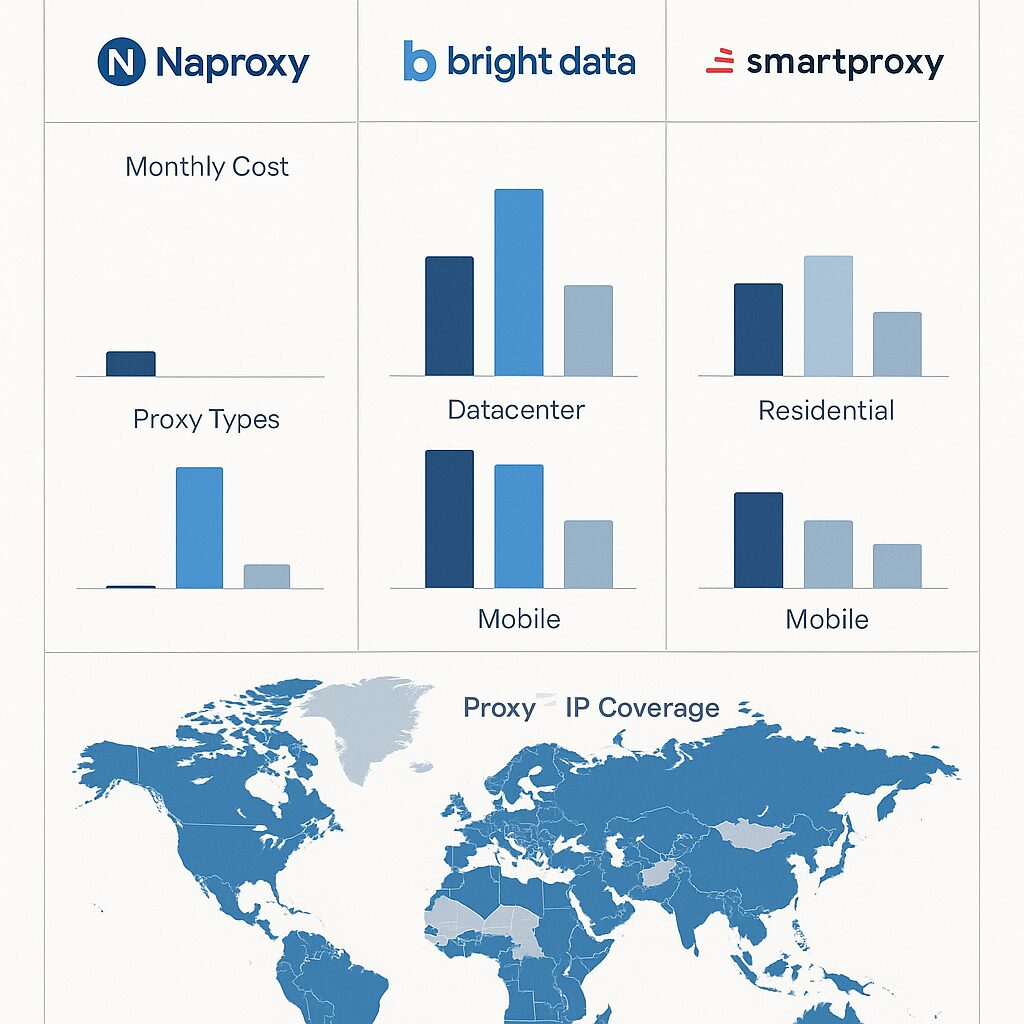
Between prepaid packages, pay-as-you-go, and monthly subscriptions, each platform offers a different recipe. For low volume (< 100,000 requests), Naproxy often appears the most economical. Conversely, for massive usage, Bright Data amortizes the cost through the robustness of its network. Smartproxy positions itself in the middle, with interesting granularity for evolving projects.
2. Diversity and coverage of IPs
The variety of IPs and geographic distribution condition your ability to simulate visits from any continent. Bright Data takes a comfortable lead here, but its complex configuration can be off-putting. Naproxy and Smartproxy cover the essential key markets (US, Europe, Asia-Pacific) and suit most marketing and SEO scenarios.
3. Rotation and anonymity
At the opposite end of a static proxy, rotation guarantees the freshness of the IP address. Depending on the sensitivity of your targets, an interval of 5 to 20 seconds is justified. At this stage, the question of confidentiality joins that of virtual private networks: to dig into the reliability of comparable solutions, one can consult the survey on Free VPNs in 2025, where data leak risks and protocol robustness are detailed.
4. Performance and latency
Controlled latency under 200 ms allows assembling several hundred requests per minute. Bright Data, thanks to its multiple points of presence (PoP), delivers stable response times. Smartproxy holds well on this ground, while Naproxy, optimized for small volumes, can suffer from a traffic spike at peak hours.
5. Integration and support
The best proxy remains the one you install painlessly. Naproxy and Smartproxy SDKs cover common languages, while Bright Data offers a complete environment (Web UI, CLI, API). In parallel, responsive support and clear SLAs are essential when your flow partly depends on these services.
Detailed use cases
Depending on your needs, each solution can take the lead:
- SEO scraping: Naproxy for moderate volume, Smartproxy for an evolving pipeline, Bright Data for web-scale scraping.
- Advertising tests: fine geolocation, multi-region A/B tests – Bright Data shines with its extensive network.
- Competitive analysis: rapid IP aggregation via Smartproxy, to compare prices and promotions in real time.
- Multiple accounts: automated management of persistent sessions thanks to Bright Data’s sticky IP or Smartproxy’s dedicated sessions.
| Use | Naproxy | Bright Data | Smartproxy |
|---|---|---|---|
| Moderate scraping | ✅ Simple Interface | ❌ Too expensive | ✅ Interesting cost/GB |
| Geo tests | ⚠️ Limited coverage | ✅ 195 countries | ✅ 195 countries |
| Sticky IP | ⚠️ Short fixed rotation | ✅ Sticky mode | ❌ Not native |
| Support & SLA | ❌ Standard ticket | ✅ Pro onboarding | ✅ Live chat |
Final recommendations
No surprise, Bright Data remains the reference for large-scale projects requiring fine control over rotation, geolocation, and proxy formats (mobility, ISP, datacenter). On the opposite side, Naproxy bets on simplicity and a contained budget, ideal for a first step into residential proxy. As for Smartproxy, it appeals to those who want a large network without exploding their bill and without sacrificing performance.
To make your choice, first clearly define your needs in terms of volume, geographic coverage, and latency. Then, test each solution on a mini-project before committing to a longer engagement. This approach ensures that your proxy will not hinder your ambitions for data collection or user experience testing.
Frequently Asked Questions (FAQ)
Q: What is the difference between a residential proxy and a datacenter proxy?
A: The residential proxy uses IPs assigned to individuals, offering a better success rate against anti-bot systems, while the datacenter is hosted in a center, faster but more easily detectable.
Q: Can multiple proxy providers be mixed?
A: Yes, a mix allows combining advantageous rates and broad coverage, while spreading the risks of blocking.
Q: What IP rotation should be favored for SEO scraping?
A: A rotation every 10–20 seconds ensures a good balance between performance and session stability.
Q: Is a VPN necessary in addition to a residential proxy?
A: A VPN can enhance the privacy of your connection, but it adds a layer of latency and is not essential if the proxy already provides strong anonymity.