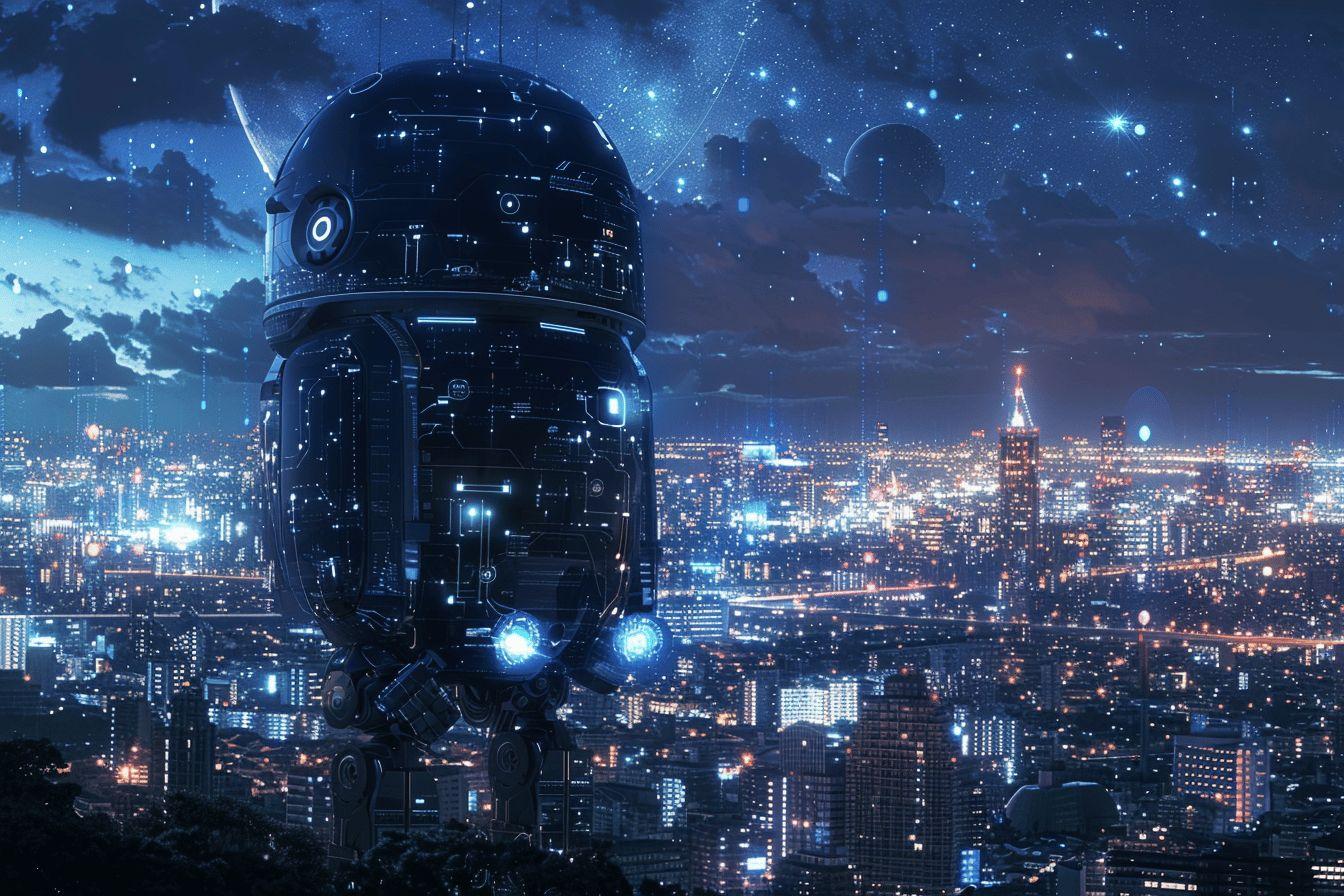
The race towards artificial intelligence surpassing humans is intensifying, but several factors still limit this evolution.
- Our self-awareness and emotional intelligence remain unmatched by machines
- Current AI, called “weak“, excels in calculations but lacks common sense and intuition
- Technical obstacles persist: GPU shortages, colossal energy demand
- The future seems to lean towards human-machine complementarity rather than replacement
The frenzied race towards artificial intelligence surpassing human capabilities is accelerating like never before! 🤖 From tech giants to research labs, everyone is brainstorming this burning question: will AI soon surpass us? Elon Musk bluntly says it could happen by the end of 2026, while Sam Altman, head of OpenAI, sees superintelligence arriving by 2033. But wait, what exactly is this singularity everyone talks about? Between disruptive potential and legitimate concerns, let’s dive into this reflection at the frontiers of our humanity.
Somaire
Artificial intelligence versus humans: the brain match
Our human intellectual capacities have something unique that machines still struggle to reproduce. Self-awareness and critical thinking remain our exclusive domain. Our brain, this little marvel weighing only 1.5 kg, manages a million trillion neuronal interactions while consuming only 25% of our body’s energy. Not bad for an organ that represents barely 1.5% of our weight! 😮
AI shines in ultra-fast calculations and massive data processing but remains confined to tasks for which it was programmed. This so-called “weak” artificial intelligence contrasts with our general intelligence capable of adapting to unprecedented situations. Laurent Alexandre, a specialist in these matters, points out that despite the phenomenal advances enabled by the NBIC revolution (nanotechnologies, biotechnologies, computing, and cognitive sciences), machines fundamentally operate differently from our biological intelligence.
The emotional factor, our competitive advantage
What radically distinguishes our human decision-making process from that of algorithms? Emotions! This affective dimension influences our creativity, empathy, and contextual understanding in a way that machines cannot replicate. Our emotional reactions guide our intuition and shape our understanding of the world. Even the most sophisticated AIs only simulate these states without truly feeling them.
Current barriers preventing AI from surpassing us
Despite rapid progress, artificial intelligence still faces major obstacles. The absence of consciousness and intuition limits its real understanding of the world. Current systems sorely lack common sense, that human faculty that seems so natural but resists algorithmization.
Machines remain prisoners of their initial programming and the training data that feed them. This dependence on training data introduces sometimes problematic biases in their problem-solving process. According to Daniel Andler, philosopher of science, the “myth of superintelligence” is simply not credible given the current state of our knowledge.
Technical challenges slowing the advent of general AI
The development of general artificial intelligence faces very concrete constraints:
- The global shortage of GPUs necessary for processing advanced learning models
- The enormous energy demand of data centers, incomparable with the efficiency of the human brain
- The lack of quality data to train these systems on diversified tasks
- The inability to develop true artificial emotional intelligence
How AI is already transforming our society and work
Automation linked to AI’s growing capabilities is already disrupting the labor market. A Goldman Sachs study reveals that up to 25% of jobs could be automated thanks to intelligent systems. The International Labour Organization estimates that 427 million jobs worldwide – about 13% of the total – will be directly impacted by this technological revolution.
Notably: women could be more affected by this transformation, with 3.7% of female jobs potentially replaced compared to 1.4% for men. This transition of professions raises crucial questions about the necessary support and new skills to develop. Beyond the numbers, it is the entire ethical dimension of algorithmic decision-making that challenges our society.
Towards human-machine complementarity rather than replacement
What if we considered the future from a more collaborative angle? 🤝 Artificial intelligence could become our best assistant rather than our replacement. This concept of co-activity between humans and machines opens fascinating prospects for augmenting our intellectual capacities rather than programmed obsolescence.
As Amélie Cordier, AI expert, points out: “jobs will not be destroyed, but work will be profoundly transformed.” Our unique capacity for problematization and taking into account the global context remains a decisive advantage over algorithms. Paradoxically, the emergence of artificial intelligences could push us to redefine what makes our very essence, encouraging us to cultivate what is fundamentally human in us.
The future is probably written in a form of symbiosis between our human and artificial intelligences, each bringing its complementary strengths. From this perspective, the question is no longer really whether machines will surpass us, but rather how we can evolve together towards forms of augmented intelligence that respect our humanity.