
| Key points | Details to remember |
|---|---|
| 🚀 | GPT‑5 brings notable improvements in **contextual understanding** and **multimodal generation**. |
| 💸 | Costs per request are higher in inference, but better value-for-money ratio for complex tasks. |
| ⚡ | Latency improved in batch and asynchronous processing, useful for real-time products. |
| 🔧 | Upward compatibility: GPT‑4 pipelines migrate, but require adjustments and re-fine tuning. |
| 🏷️ | Use cases: complex assistants, creative production, HR and FinOps tools, and advanced document research. |
In 2025, the debate is no longer simply “Is GPT‑5 better?” but rather “Where and at what cost do these gains really serve my product?”. This comparison breaks down the concrete differences between GPT‑5 and GPT‑4: measurable performance, cost model, latency, and convincing use cases by sector. Here you will find elements to decide whether to migrate, optimize your tech stack, or simply to argue a product choice with your teams.
Somaire
Technical overview
GPT‑5 represents a multifaceted evolution: extended contextual capacity, better management of multimodality (text, image, sometimes audio), and more efficient internal mechanisms for disambiguation. GPT‑4 remains solid, particularly for classic textual tasks and use cases where latency and cost are critical. You gain finesse with GPT‑5, but operational complexity also increases: more precise tuning, larger reference datasets, and more demanding inference resources.
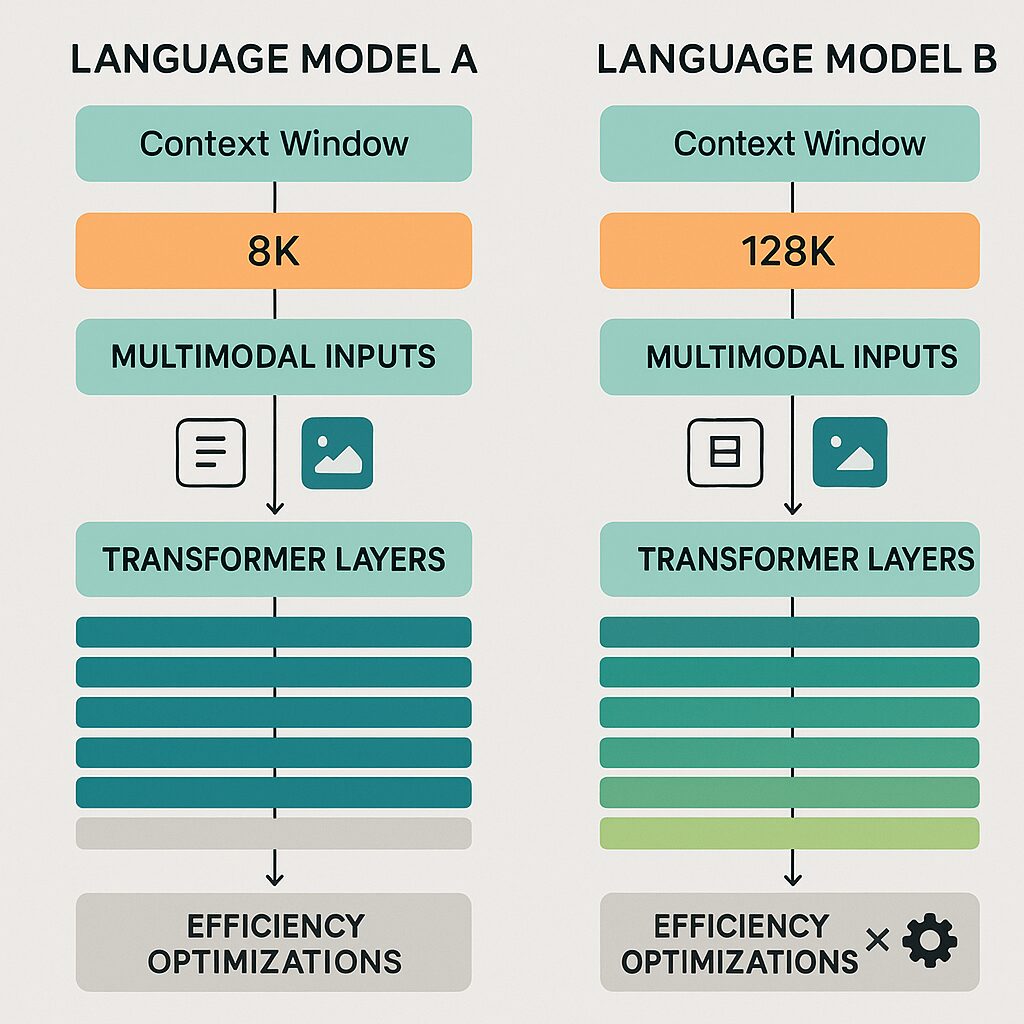
Practically speaking, GPT‑5 introduces internal optimizations that reduce certain types of errors — attenuated semantic hallucinations for complex prompts, and better performance on long dialogues. These improvements translate into clear gains in workflows where robustness is key: customer support, business assistants, technical writing. However, for simple summaries or short queries, the perceived difference is sometimes marginal.
Performance: accuracy, robustness, and latency
Accuracy and understanding
GPT-5 shows progress on three fronts: understanding ambiguous statements, extended conversation tracking, and coherent generation under formal constraints. Concrete examples: more reliable multi-source document synthesis, reformulation respecting strict stylistic rules, and legal or financial responses less prone to gross errors. Therefore, GPT-5 can be entrusted with tasks demanding context and rigor.
Latency and throughput
The average latency per request has decreased when optimized inference modes are activated. In practice, GPT-5 proves more efficient in batch and parallel execution, while latency spikes remain sensitive to context (prompt size, multimodality). For real-time applications (chat, voice bots), the choice of model will depend on latency tolerance and targeted SLA: GPT-5 often requires a trade-off between speed and response richness.
| Metric | GPT-5 (typical) | GPT-4 (typical) |
|---|---|---|
| Accuracy on complex tasks | +10–20% | Solid baseline |
| Latency (average, ms) | +10–30% variable depending on mode | Stable and slightly lower |
| Conversational robustness | Better in long dialogues | Good but faster decline |
Costs and business models
Prices in 2025 reflect the added technical value. GPT-5 boasts a generally higher per-token rate than GPT-4, especially for multimodal or low-latency endpoints. But cost/value analysis is not limited to the gross price: error rates, human post-editing needs, and development time must be considered. For projects requiring little supervision, GPT-5 can reduce human costs and offset its higher price.
- Inference costs: GPT-5 > GPT-4 in per-token pricing, especially for long or multimodal responses.
- Operational costs: required GPU and memory increase, sometimes leading to additional infrastructure expenses.
- Human costs: potential reduction thanks to more reliable results, less rework, and less validation.
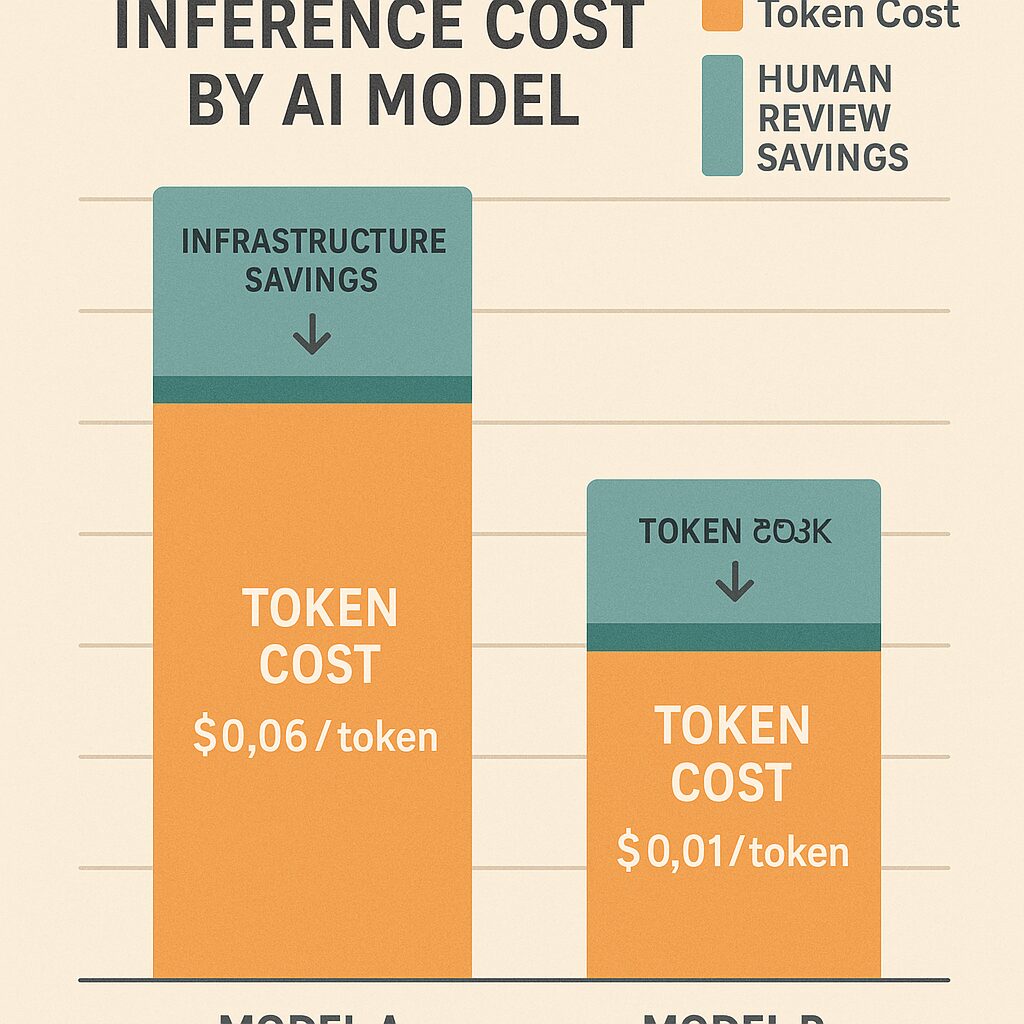
A simple reflection table: if your teams spend time correcting model outputs, the return on investment can quickly favor GPT-5. Conversely, for low-stakes content or prototypes, GPT-4 remains the pragmatic choice.
Use cases by sector
GPT-5 does not reinvent all professions, but it opens new possibilities where nuance and multimodality matter.
Health
In writing clinical notes, extracting information from images, and literature synthesis, GPT-5 improves quality and reduces the need for human intervention. However, beware of regulatory requirements and validation: a more capable model also demands strengthened control pipelines.
Finance and legal
For generating contractual documents or compliance review, GPT-5 reduces semantic errors and better manages formal constraints. It remains essential to add layers of human verification and business rules to avoid legal risks.
Product and User Experience
Conversational assistants are becoming more proactive and contextual. GPT‑5 enables more natural interactions, the ability to continue a thread across multiple sessions, and to integrate visual elements into the dialogue, offering enriched UX scenarios — interactive tutorials, personalized onboarding, and dynamic generation of marketing content.

Migrations and Compatibility
Switching from GPT‑4 to GPT‑5 is not always plug-and-play. Prompts optimized for GPT‑4 generally work, but to fully leverage GPT‑5, it is better to rethink prompt engineering, chunking strategies, and fine-tuning. Moreover, preserving logs and test sets is crucial to measure differences and avoid regressions.
- A/B testing: compare performance on real metrics.
- Progressive validation: start with non-critical features.
- Optimize prompts: to reduce costs and latency.
How to Choose in 2025: Practical Checklist
Choosing is not a matter of technological ego; it is an economic and product decision. Here is a checklist that clarifies the path:
- Define business KPIs: acceptable error rate, processing time, cost per operation.
- Measure the real cost of human correction today.
- Conduct tests on real cases (A/B) and measure net improvement per dollar spent.
- Plan a rollback strategy if the migration impacts the customer experience.
- Document new infrastructure needs (GPU, scaling, network costs).
FAQ
Is GPT‑5 worth the investment for an SME?
If your SME heavily depends on output quality (customer support, compliance, specialized content), yes: the investment can reduce human costs and improve satisfaction. For exploratory uses or prototypes, GPT‑4 often remains more reasonable.
Are the models interchangeable in production?
In practice, yes for standard uses. But to leverage GPT‑5’s strengths, you will need to adapt prompts, pipelines, and monitoring. A hybrid strategy (GPT‑4 for simple tasks, GPT‑5 for critical tasks) is often the best transition.
How to limit costs if adopting GPT‑5?
Some levers: prompt engineering to reduce response length, caching frequent responses, batch processing, and using lighter models for intermediate steps (sorting, routing).
Practical Conclusion
GPT‑5 is a useful evolution when complexity and business requirements justify the extra cost. GPT‑4 remains relevant for standard operations and rapid prototypes. The optimal choice often combines both: GPT‑5 for high-value tasks, GPT‑4 for scale and low-risk uses.
{
“@context”: “https://schema.org”,
“@type”: “FAQPage”,
“mainEntity”: [
{
“@type”: “Question”,
“name”: “Is GPT‑5 worth the investment for an SME?”,
“acceptedAnswer”: {
“@type”: “Answer”,
“text”: “If your SME heavily depends on the quality of outputs, the investment can reduce human costs and improve satisfaction; for exploratory uses, GPT‑4 remains more reasonable.”
}
},
{
“@type”: “Question”,
“name”: “Are the models interchangeable in production?”,
“acceptedAnswer”: {
“@type”: “Answer”,
“text”: “Yes for standard uses, but fully exploiting GPT‑5 requires adapting prompts, pipelines, and monitoring; a hybrid strategy is often recommended.”
}
},
{
“@type”: “Question”,
“name”: “How to limit costs if adopting GPT‑5?”,
“acceptedAnswer”: {
“@type”: “Answer”,
“text”: “Optimizing prompts, caching frequent responses, using batch processing, and lighter models for certain steps help reduce the bill.”
}
}
]
}
{
“@context”: “https://schema.org”,
“@type”: “WebPage”,
“about”: {
“@type”: “Thing”,
“name”: “GPT‑5 vs GPT‑4 Comparison — performance and use cases 2025”
},
“keywords”: [“GPT-5”, “GPT-4”, “performance”, “costs”, “use cases”]
}