Update: August 2025 – Reading time: 12 minutes
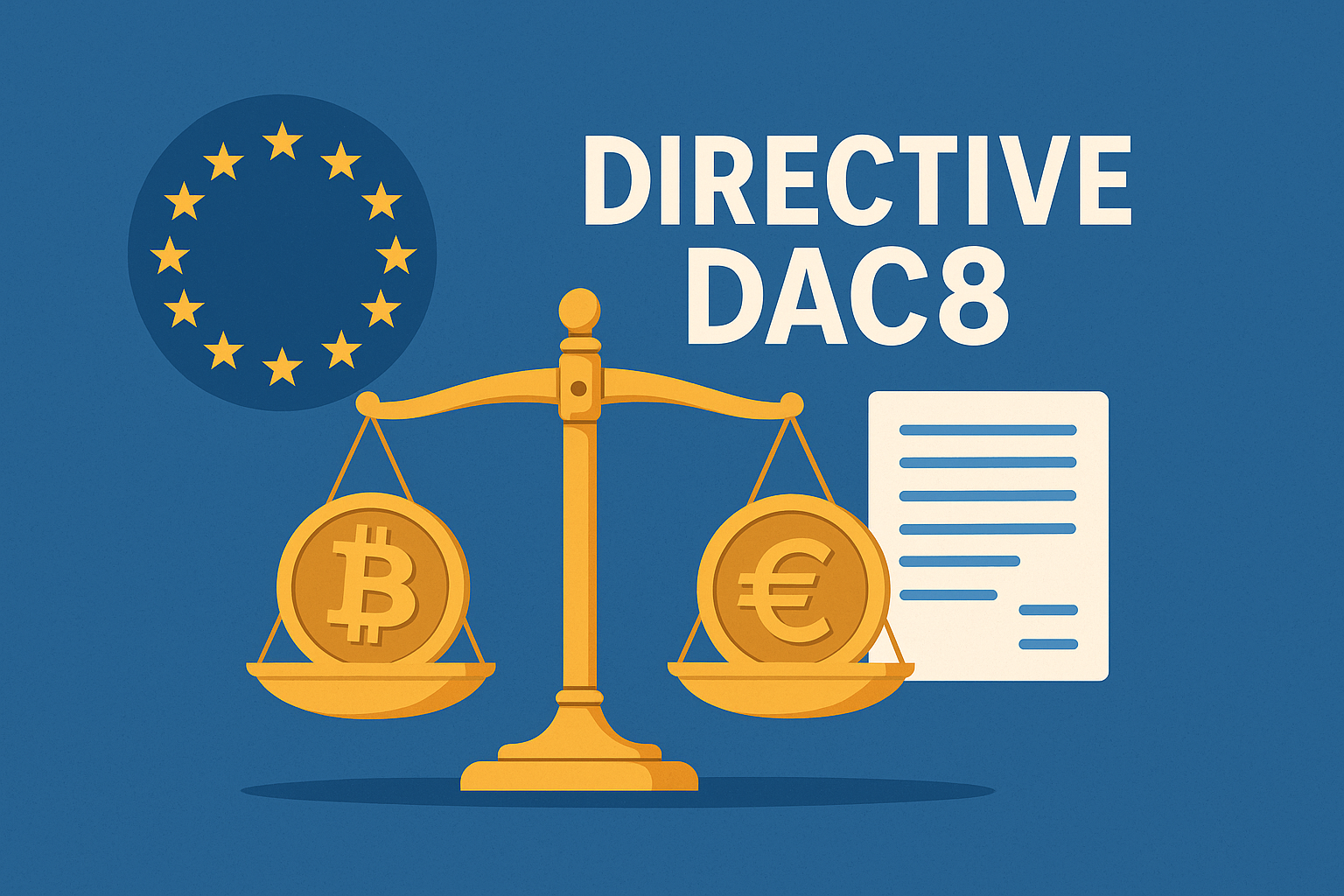
The taxation of crypto-assets enters a new dimension with the arrival of the DAC8 Directive, adopted by the European Union in October 2023. This text marks a historic turning point: for the first time, transactions in cryptocurrencies, stablecoins, and certain NFTs will be integrated into the system of automatic exchange of tax information between Member States. Starting in 2026, platforms and providers will have to identify, collect, and transmit to tax authorities a large amount of data concerning their European clients. For investors as well as for industry players, this is a silent revolution but one with significant consequences. This article provides an in-depth overview of what you need to know and anticipate.
Somaire
📜 History: from DAC1 to DAC8
The DAC8 directive is part of a series of European texts aimed at strengthening tax transparency. Since 2011, the DAC directives (for “Directive on Administrative Cooperation”) have gradually expanded the scope of automatic information exchange:
- DAC1 (2011): basic administrative cooperation in tax matters.
- DAC2 (2014): integration of the OECD’s CRS (Common Reporting Standard), covering traditional financial accounts.
- DAC3 and DAC4: extension to tax rulings and multinationals.
- DAC6: obligation to report certain cross-border tax arrangements.
- DAC7: obligations for digital platforms (Airbnb, Vinted, etc.).
DAC8 represents a real qualitative leap: it targets a domain until now largely opaque, that of crypto-assets, whose capitalization now exceeds 2,000 billion dollars worldwide.
🎯 Objectives and scope of DAC8
With DAC8, the European Union intends to fill a regulatory gap. The text is based on the international framework CARF (Crypto-Asset Reporting Framework) developed by the OECD, and adapts it to the European context.
Who is concerned?
- All Crypto-Asset Service Providers (CASP) defined by the MiCA regulation, including PSANs in France.
- Providers outside the EU who provide services to European residents must also comply, through registration in a Member State.
- Individual investors, who should expect their transactions to be automatically communicated to their tax administration.
Which assets and transactions are covered?
- Cryptocurrencies (Bitcoin, Ethereum, etc.).
- Stablecoins and tokens backed by currencies or assets.
- Certain NFTs, depending on their use.
- Crypto-to-crypto and crypto-to-fiat exchanges.
- Transfers between wallets, crypto payments, airdrops, donations.
📑 Obligations of providers
Platforms will need to implement rigorous due diligence procedures. Specifically:
- Identify each client with their personal data (name, address, country of tax residence, TIN number, date and place of birth).
- Assign a unique crypto account identifier.
- Store the data and regularly verify its accuracy.
- Transmit the information to the national tax authority before January 31 of the following year.
This data will then be automatically exchanged between member states, meaning that a French tax resident using a foreign platform will have their information sent directly to the French tax authorities.
📅 Implementation Timeline
- Adoption: October 17, 2023
- Entry into force: November 13, 2023
- Transposition by member states: no later than December 31, 2025
- Effective application: January 1, 2026
- First declarations: early 2027, covering the year 2026
⚖️ Sanctions Provided
The directive requires member states to establish deterrent sanctions. In France, the 2025 finance law provides for:
- €15 per undeclared or late-declared transaction, capped at €2,000,000 per year per provider.
- Up to a €50,000 fine for failure to comply with verification and due diligence obligations.
- Standard tax penalties (late payment interest, surcharges) for taxpayers who fail to declare their crypto income.
🔎 Issues for Platforms and Investors
The arrival of DAC8 will profoundly change the ecosystem:
- For platforms: the need to invest heavily in compliance, data collection, and automation of reporting processes.
- For investors: the end of tax anonymity, with an increased risk of adjustments in case of non-declaration.
- For states: improved fight against tax fraud and strengthening of public revenues.
🌍 International Comparison: the Role of CARF
DAC8 is not an isolated initiative. It is part of a global movement initiated by the OECD with the Crypto-Asset Reporting Framework (CARF). The goal: to harmonize practices internationally and prevent capital flight to opaque jurisdictions. The United States, the OECD, and several G20 countries are moving in the same direction, with similar reporting mechanisms.
❓ FAQ: Your Questions About DAC8
- When will the directive apply? From January 1, 2026, with first declarations in 2027.
- Who is concerned? All crypto platforms, including those outside the EU if they serve European clients.
- Which assets are targeted? Cryptos, stablecoins, certain NFTs, crypto payments and transfers.
- What risks does an investor face if they do not declare? Financial penalties, tax surcharges, and adjustments.
- How does DAC8 differ from MiCA? MiCA regulates markets and investor protection, DAC8 targets taxation and tax transparency.
🚀 Conclusion and call to action
The DAC8 directive opens a new era for crypto taxation in Europe. By requiring providers to act as reporting intermediaries, the EU significantly reduces the opacity of crypto-asset transactions. For platforms, this is a major technological and organizational challenge. For investors, it marks the end of a tax gray area.
Our advice: if you are an investor, start today to keep clear records of your crypto operations. If you are a provider, anticipate now the necessary adaptations of your systems. In all cases, consult a tax expert to avoid unpleasant surprises in 2026.