
| Key Points | Details to Remember |
|---|---|
| 📚 Definition of Formaxio | Explore the nature and purpose of this learning system. |
| ⚙️ Mode of Operation | Understand how AI adapts content and learning paths. |
| 💡 Educational Innovations | Analyze the benefits and limits of personalization. |
| 📉 Risks for Traditional Teaching | Identify the threats weighing on the classic model. |
| 🌐 Accessibility and Audiences | Measure the impact on distant and diverse learners. |
| 🔄 Evolution Perspectives | Project scenarios of coexistence or replacement. |
The question stirs teachers, decision-makers, and students alike: Formaxio, an AI-assisted learning platform, is it making traditional teaching obsolete? On one hand, it is described as a revolution as profound as that of the printing press; on the other, concerns grow about the possible disappearance of human interaction at the heart of classrooms. Without falling into sterile alarmism, this article aims to decipher the issues, to put concrete testimonies into perspective, and to consider how, perhaps, these two worlds can merge.
Somaire
What is Formaxio?
Origin and Genesis
Launched only three years ago by a group of educational engineers and AI experts, Formaxio claims a disruptive positioning. Rather than a simple catalog of online courses, the platform feeds on usage data to refine educational content in real time. One might think this mechanism is a technological gimmick, but early feedback reports increased learner progress, especially in scientific disciplines.
Key Features
Obviously, what distinguishes Formaxio is its adaptive engine capable of recalibrating difficulty, proposing targeted exercises, and anticipating cognitive blocks. The system analyzes browsing history, response pace, and even the emotional tone of comments to offer tailored quizzes or videos. This added value makes some traditional institutions hesitate, wondering if their model, centered on the lecture class, is too rigid.
The Advantages of Formaxio for Education
Personalization of Learning
Unlike a classroom session where the teacher must balance beginners and advanced students, Formaxio automatically segments profiles. You follow an exercise path that precisely matches your level. In a classroom of 30 students, a teacher cannot offer this granularity; Formaxio can. Result: the student remains engaged because they are neither overloaded with unknown concepts nor bored by unnecessary reviews.
Flexibility and Autonomy
We know how chaotic learners’ schedules can be. Student jobs, family responsibilities, travel… Formaxio connects 24/7 from any device. This freedom creates a sense of personal control, where the traditional “9am-12pm, 2pm-5pm” teaching format imposes a framework sometimes poorly adapted to modern realities.
Concerns Around Traditional Teaching
Risk of Dehumanization
Some educators fear that AI will reduce the teacher to a mere technical supervisor. Exchange, emotional support, and motivation traditionally come through the teacher’s gaze, discussion, and kindness. With Formaxio, it shifts towards a wall of screens: the machine proposes, the learner executes. The absence of human feedback can leave the feeling of being alone with one’s doubts.
Competition for Teachers
More pragmatically: what about the professional future of teachers? In some universities, undergraduate lectures could be purely and simply entrusted to the algorithm. We already see institutions reducing their teaching staff, convinced that an automated system is more economical. This is not yet widespread, but the shadow of partial unemployment for trainers looms.
Towards Coexistence or Replacement?
Hybrid Models
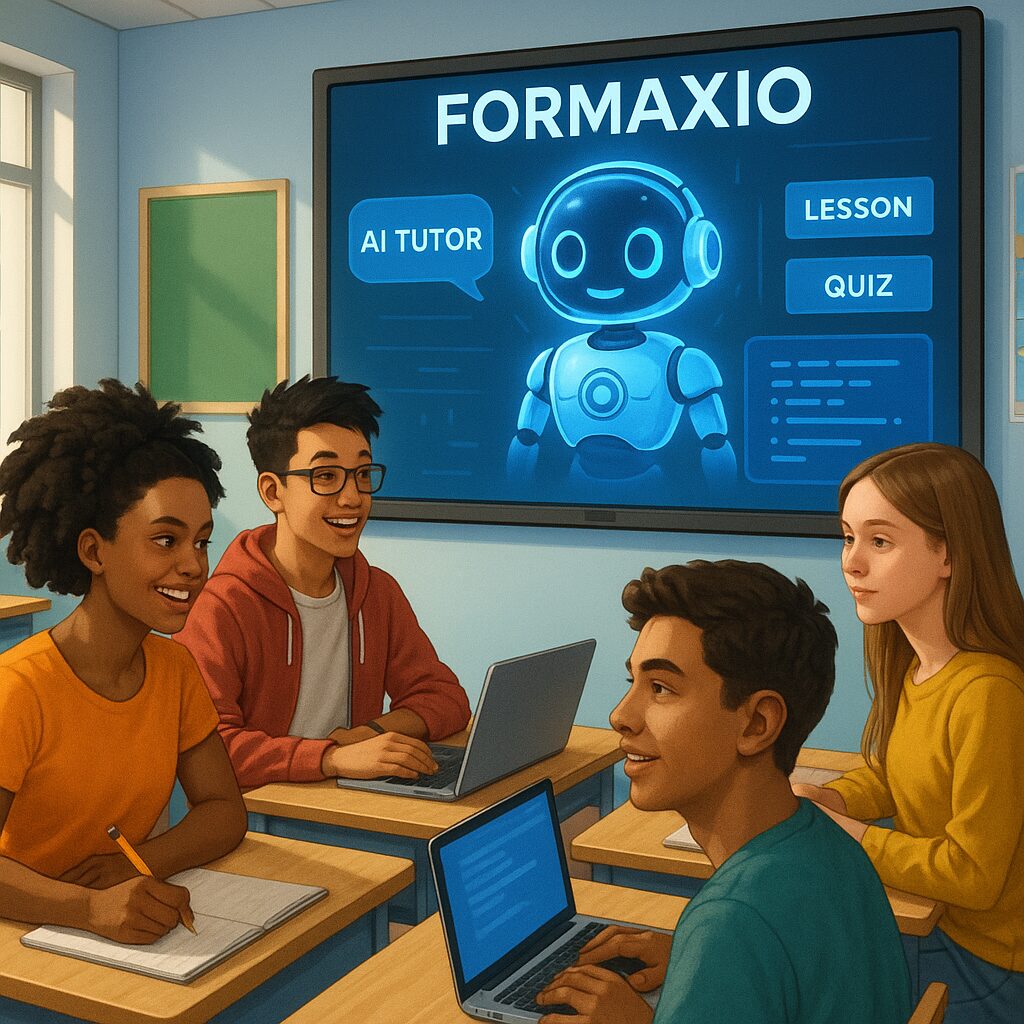
In reality, the battle seems less binary than imagined: several schools are experimenting with mixed formulas where Formaxio handles the acquisition of fundamental notions, while the teacher focuses on leading debates, role-playing, or solving concrete problems. This is called a flipped pedagogy where the classroom becomes a space for collaboration and creativity.
Future Role of Teachers
Rather than teaching by rote, teachers become mentors, knowledge mediators, and designers of playful activities. They ensure group cohesion, identify social or behavioral difficulties, and provide critical insight into content produced by AI. In short, they become human intermediaries again, essential for understanding the “why” more than the “how.”
Testimonials and Case Studies
“I gained almost ten points on average after two months on Formaxio. I had never understood trigonometry in math, and there, the exercises adapted to my pace.” – Léa, 17 years old.
“The platform freed up time for me to work on my practical workshops. I use this margin to have students discuss in small groups.” – Prof. Dupont, technical high school.
North American universities have published studies showing a 15% increase in retention rates among students using Formaxio to prepare for exams. However, caution remains: these results are based on voluntary cohorts, often already highly motivated.
Frequently Asked Questions
- Does Formaxio completely replace teachers?
- No : rather than a total replacement, there is a redistribution of tasks. AI handles the routine, while the teacher focuses on human support.
- What is the cost for an institution integrating Formaxio?
- The price varies depending on the number of users, but some universities obtain discounted rates in exchange for case studies or co-development.
- Can it be used without an Internet connection?
- An offline version is being rolled out, but the optimal experience remains online to benefit from updates and data analysis.
- Are inequalities likely to arise?
- Yes, the cost of equipment or access to high-speed internet can create a gap. This is a challenge that several NGOs and governments are trying to address.