
| Key Points | Details to Remember |
|---|---|
| 🛠 Definition of Majestic SEO | Understand the tool and its main objectives |
| 📊 Main metrics | Analyze Trust Flow, Citation Flow, and Index |
| 🔍 Backlink analysis | Filter the origin and quality of links |
| 📈 Link building strategies | Optimize acquisition and campaign tracking |
| 📜 Historical index | Explore the evolution of your link profile |
| 🤖 API integration | Automate reports and audits at scale |
Majestic SEO establishes itself as a reference when it comes to exploring and leveraging your link network. In this guide, we dive into the heart of the most relevant features: from fundamental metrics to detailed reports, up to the possibilities offered by the API. The goal? To provide you with a clear and practical vision to strengthen your link building, whether it’s a launching site or a well-established platform. You will quickly notice that Majestic, with its wealth of data, becomes a preferred ally rather than just an additional tool.
Somaire
Why Majestic SEO is an asset for your link building
When approaching the concept of link building, quality takes precedence over quantity. Majestic SEO offers unique indicators, such as Trust Flow, to assess the reliability of referring sites. It’s not just a score: it reflects a web of trust woven between high-authority pages.
Moreover, by crossing these measures with Citation Flow (which reflects raw popularity), you get a dual perspective: one on influence, the other on notoriety. This combination allows you to identify precise action points: favoring domain age, or targeting recent publications capable of quickly spreading your content.
Understanding Majestic’s key metrics
Trust Flow and Citation Flow: a revealing duo
Trust Flow represents the trust granted to a domain based on the quality of the sites linking to it. Its value is based on an authority graph previously built by Majestic. Conversely, Citation Flow evaluates the proliferation of backlinks, without considering their qualitative profile. In reality, too large a gap between these two scores can signal a campaign too focused on quantity: a point of attention to avoid being penalized by Google.
Practically speaking, one ensures that these two indicators evolve together. When you spot a prospect with a Trust Flow above 20 and an equivalent Citation Flow, you are probably dealing with a credible and active site.
Fresh Index and Historic Index: moving from recent to historical
Majestic has two complementary indexes. The Fresh Index lists links discovered over the past few weeks, ideal for monitoring new acquisitions. The Historic Index, on the other hand, sometimes goes back ten years of data. It is a treasure for anyone wanting to trace the evolution of a link profile, identify old campaigns, and understand how a site climbed its rankings over time.
By using it, you can detect not only link breaks but also forgotten opportunities: those quality partners with whom collaboration deserves to be renewed.
Using the Backlink Analyzer tool
Real-time analysis and personalized alerts
The Backlink Analyzer offers an instant reading of all links pointing to your domain. Rather than waiting for a monthly report, you can set alerts when new backlinks appear or disappear. This responsiveness is valuable for detecting an unexpected boost or, conversely, a significant loss of links, potentially related to a technical issue or a less scrupulous competitor.
You can thus receive notifications by email or consult the dashboard, which updates continuously. A reassuring feature when managing multiple sites simultaneously.
Advanced filtering to isolate quality links
Not all backlinks are equal. Thanks to filtering, you can segment your list according to Trust Flow, Citation Flow, the source domain’s language, or even the discovery date. Imagine you want to work with French-speaking blogs published less than six months ago: a simple click is enough to reduce your prospecting to a few dozen relevant targets.
Additionally, the “Topical Trust Flow” tool segments these analyses by theme: sports, technology, health… You then focus on sites that truly share your editorial universe.
Optimizing your netlinking strategy with Majestic reports
Segmenting your campaigns according to prospects
By segmenting your reports, you establish a precise plan for each type of partner: influencers, specialized directories, corporate sites, etc. Majestic even offers CSV exports, which you can work on in Excel or Google Sheets. You then create dynamic pivot tables to cross quality, potential cost, and editorial relevance, and decide where to focus your efforts.
This methodical approach avoids random actions and maximizes return on investment. You take fewer risks while cultivating stronger relationships.
Tracking the evolution of backlinks
A backlink is not set in stone. CMS updates, migrations, or page deletions can lead to link loss. Majestic allows you to track each URL chronologically and anticipate breaks. By using alerts, you can quickly contact the concerned publisher to reactivate a disappeared link.
This proactive approach often results in longer-lasting partnerships and, in the long term, better stability of your netlinking in Google’s eyes.
Integrations and automations via the Majestic API
Automating backlink audits
Do you have a significant volume of domains to audit? The Majestic API allows you to schedule automatic requests. Every morning, your script can retrieve new backlinks, analyze them, and feed an internal dashboard. You save considerable time and focus your efforts on interpreting results rather than collecting data.
No more risk of forgetting or handling errors: everything is orchestrated and reproducible, even for a team not specialized in SEO.
Customize Your Dashboards
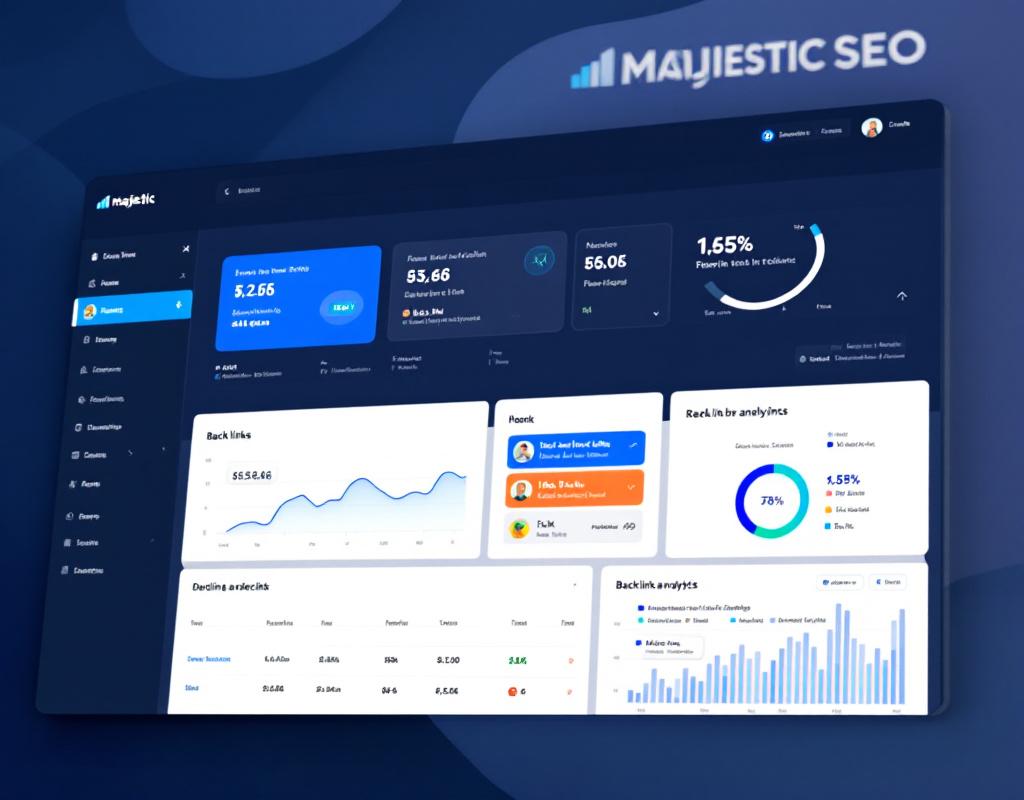
The API is not limited to raw numbers. By coupling it with a visualization tool (Google Data Studio, Tableau, Power BI…), you design a custom dashboard. Your clients see in real time the impact of netlinking actions: evolution of Trust Flow, peaks of new publications, clear removals of toxic links. Transparency strengthens trust and justifies your expertise.
Beyond SEO, it is a real decision-making support for marketing and communication managers.
Case Study Illustrating the Impact of Majestic
Let’s take the example of an SME specializing in sports equipment. At the beginning of 2022, its average Trust Flow stagnated around 12, despite a steady flow of backlinks. After a thorough audit via Majestic, two categories of links to strengthen were identified: on the one hand, influential running blogs, and on the other hand, thematic e-commerce sites.
Within four months, thanks to automated reports and alerts, the SME increased its Trust Flow to 25. Visibility on competitive queries improved by 30%, and the organic share of overall traffic by 18%. This success is due to Majestic’s ability to provide actionable data and the rigor in implementing a targeted strategy.
Frequently Asked Questions (FAQ)
1. What is Trust Flow in Majestic SEO?
Trust Flow is an index measuring the reliability of a site based on the quality of the domains linking to it. The more reputable the referring sites, the higher the Trust Flow, providing a strong signal for netlinking.
2. How to interpret the gap between Trust Flow and Citation Flow?
A high gap (Citation Flow >> Trust Flow) often indicates an accumulation of links without real authority. It is then necessary to prioritize backlinks from trusted domains to rebalance these scores.
3. What are the purposes of the Fresh Index and the Historic Index?
The Fresh Index lists recent links, ideal for monitoring weekly dynamics. The Historic Index explores the complete history of a domain, useful for tracing past strategies and recovering former partners.
4. Can reports be automated via the Majestic API?
Absolutely. The API allows you to schedule requests to retrieve your backlink and metric data daily, which facilitates overall monitoring and the production of customized dashboards.