
| Key points | Details to remember |
|---|---|
| 🧩 Definition | Ro Scrabble here refers to online games and the community around digital Scrabble. |
| ⚠️ Problem | Cheating and bots undermine trust in games and tournaments. |
| 🛠️ Tools | Technical filters, human tests, and tournament rules help limit abuse. |
| ⚖️ Debate | Regulating involves balancing integrity and freedom of use. |
| ✅ Recommendation | Competition modes without aids + platform transparency to preserve fairness. |
Ro Scrabble — whether we talk about a community server, a mobile app, or a simple network of online games — crystallizes an old dilemma: how to reconcile the desire to optimize one’s score with the necessity to keep the game fair? Between programs that suggest moves, automated accounts, and passionate player reactions, controversy is never far away. This article aims to clearly outline the issues, explore anti-cheating methods, and assess whether regulating online aids would be proportionate and feasible.
Somaire
What is meant by “online aids” and why they pose a problem
The range of available aids goes from a simple electronic dictionary to solvers that find the best placement in a fraction of a second. Some aids are educational: dictionaries, anagram solvers to learn. Others are purely competitive: real-time suggestions, recalculation of the maximum score, optimized exchanges. The problem arises when these tools are used during games where one expects to rely on human skill. There, the boundary between acceptable assistance and blatant cheating becomes blurred.
A useful nuance: educational aid vs unfair advantage
One might think that banning all forms of aid solves the problem. In reality, it’s not that simple: for beginners, an integrated dictionary is a learning tool. The real criterion therefore depends less on the presence of an assistant than on the context of use — friendly game, ranked game, official tournament. A good system distinguishes the “training” mode from the “competition” mode. Without this granularity, two audiences are disappointed: novices who are learning and competitors who want a fair playing field.
Common cheating methods and how to detect them
Cheaters’ creativity is surprising: multiple accounts to manipulate pairings, scripts that play 24/7, or even human players consulting a solver in parallel. Identifying these behaviors relies on often subtle but verifiable clues thanks to digital traces.
- Timing analysis: constant and ultra-fast moves are suspected, especially when the quality of the moves clearly exceeds the player’s historical profile.
- Pattern recognition: repetition of precise placements, systematic use of rare words — a sign of an algorithm.
- Interconnected accounts: networks of accounts with winning exchange schemes to inflate statistics.
These signals do not constitute absolute proof. Responsible detection combines several criteria, documents decisions, and provides an appeal path for the accused player.
Modern detection techniques
Platforms are beginning to complement classic rules with technical methods: machine learning to compare playing styles, score expectancy (expected score estimation), and manual audits for doubtful cases. The balance is to automate filtering without turning the platform into Big Brother: transparency of algorithms, publication of criteria, and limitation of false positives are essential for the community to accept the measures.
Should online aids be regulated? Advantages and risks
Regulating means defining clear rules, applying them, and possibly sanctioning. The advantages are visible: restoring trust, attractiveness for competitions, protecting the time invested by honest players. But regulation has a cost and side effects.
| Measure | Effectiveness | Complexity | Impact on players |
|---|---|---|---|
| Modes without aids | High for competitions | Medium | Clear for competitors, neutral for casuals |
| Algorithmic detection | Good, but imperfectible | High | Risk of false positives |
| Community sanctions | Variable | Low | Encourages player responsibility |
| Human verifications | Very good | Very high | Costly but fair |
The real question is not only “should we” but “how”. A strict ban without control means is ineffective. Conversely, intrusive surveillance would destroy the friendly aspect of informal games. So the most realistic regulation combines targeted technical rules, clear mode choices, and participatory governance.
Concrete proposals for proportionate regulation
Here are pragmatic measures, classified according to whether they address platforms, tournament organizers, or players.
For platforms
- Offer a “competition mode” by default without any external aid and a “training mode” where suggestions are allowed.
- Set up an alert system based on timing and move quality, then trigger a human review before sanction.
- Publish an annual transparency report on detected cheating cases and actions taken, to restore trust.
For tournament organizers
- Require screenshots, verify game logs, and use live monitored sessions for finals.
- Standardize appeal rules for sanctioned players (clear procedure and response time).
For players
- Adopt a code of ethics: indicate the chosen mode before the game, respect tournament rules, report suspicious behavior.
- Prefer transparent platforms active in fighting cheating.
Ethical and community consequences
Regulating also means influencing the gaming culture. Too much control can push players towards unsupervised environments, often worse. Too much laxity ruins serious competition. The healthiest outcome relies on informed consent: when you enter a game, you know if aids are allowed. This simplicity reduces tensions and respects the diversity of uses.
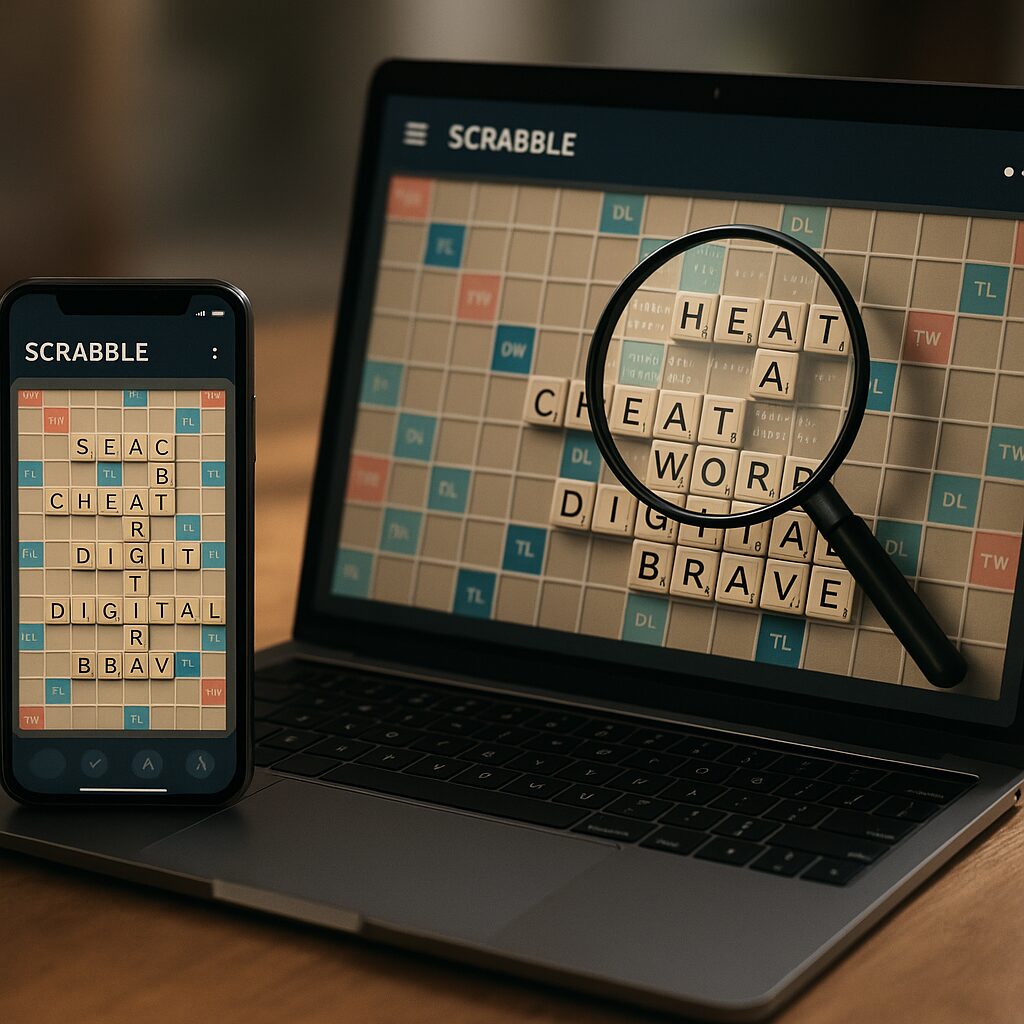
Generation prompt: “Photo-realistic image of a digital Scrabble game on a wooden table, showing a smartphone and laptop side by side. On the screen, a Scrabble board with tiles, subtle overlays of code and a magnifying glass hovering above certain words to symbolize bot detection. Warm natural lighting, modern web-app interface, high detail, cinematic depth of field.”
SEO optimized slug: scrabble-bots-cheating-regulation
Alt text: Digital Scrabble board with magnifying glass and lines of code suggesting bot detection
Practical scenarios: three cases and their responses
Let’s illustrate with plausible situations to see what really works.
Case A — casual player surprised by a gifted opponent
Reasonable response: report the behavior to support, request a review. If the platform offers a training mode, restart by choosing that mode. In most cases, the emotion passes and the explanation suffices — the opponent was perhaps just very experienced.
Case B — online tournament with suspicious victories
Response: organize a formal investigation, require logs and replays, and temporarily suspend the ranking during verification. Transparency about the procedure is crucial to avoid escalation of public accusations.
Case C — presence of numerous bot accounts
Technical response: block suspicious IPs, strengthen CAPTCHA, limit registrations per email address, then trigger a purge accompanied by a message to the community. Clear communication avoids rumors and panic-buying of accusations.
Practical conclusion: regulate yes, but intelligently
Banning all aids would be a wasted effort and counterproductive for learning; letting things go without rules will kill serious competition. The solution lies in simple design choices: distinct modes, combined detection with human review, public reports, and appeal procedures. In the end, the best regulation protects the enjoyment and competitiveness of the game, without turning every match into a courtroom.
FAQ
How to know if an opponent is using a bot?
Look at the consistency of the game tempo, the quality of moves compared to the player’s history, and the systematic use of rare words. Report your observations to support by attaching replays and screenshots.
Do platforms have an interest in regulating?
Yes: a platform perceived as fair retains its players better and attracts tournaments. But regulation costs in development and moderation; its implementation must be gradual and transparent.
Can one play honestly while using learning tools?
Absolutely. The idea is to separate uses: training to learn, competition to measure skills. Many platforms offer this ergonomics and this compromise works well.
What to do if I am unfairly sanctioned?
Follow the provided appeal procedure, provide evidence and logs, and remain factual. Serious platforms have a review mechanism and a timeframe to correct errors.
{
“@context”: “https://schema.org”,
“@type”: “WebPage”,
“about”: {
“@type”: “Thing”,
“name”: “Regulation of online aids for Scrabble (cheating and bots)”
},
“keywords”: [“Scrabble”, “cheating”, “bots”, “regulation”, “online aids”]
}