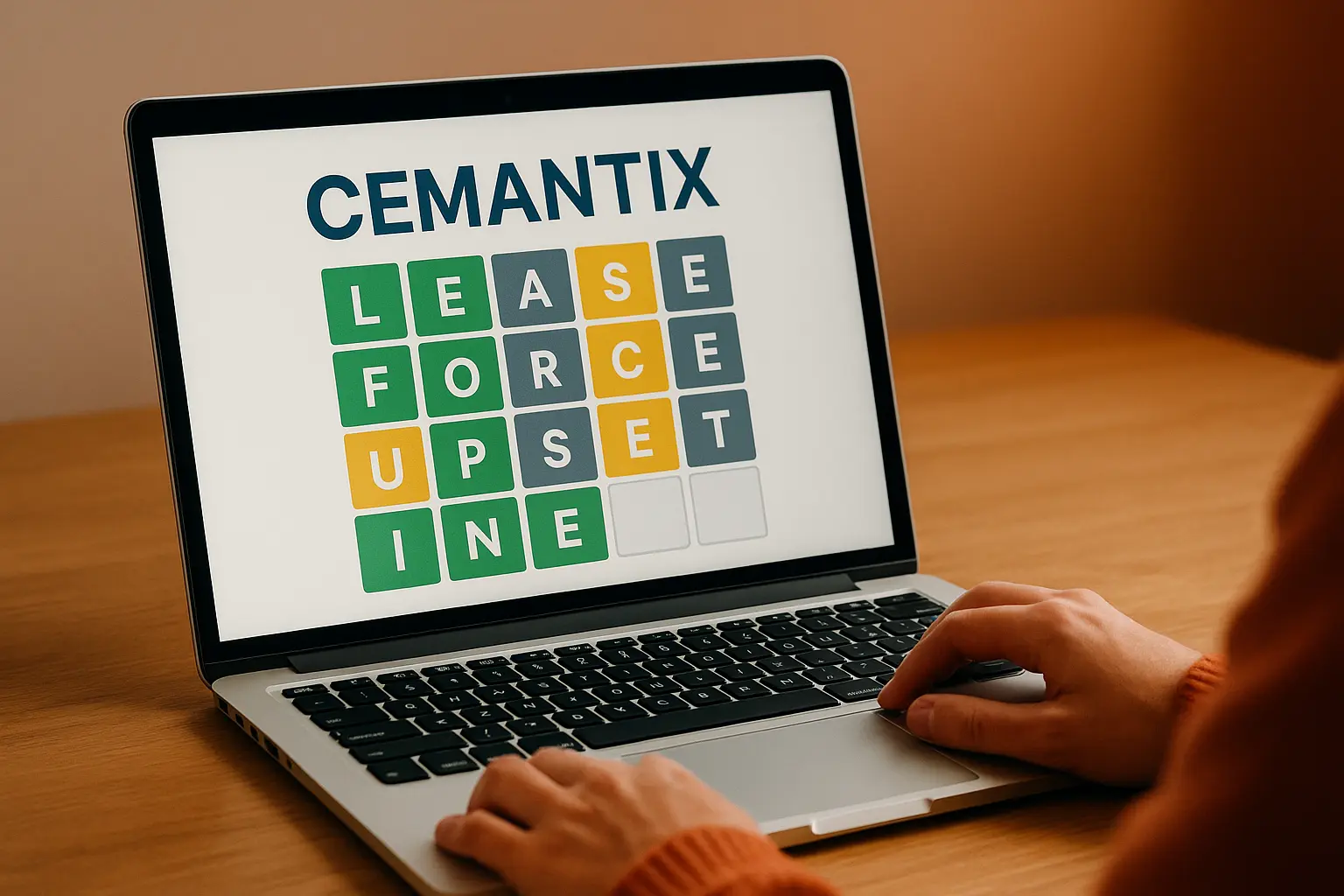
Cémantix is a daily online game consisting of guessing a secret word based on its semantics. Inspired by Semantle and offered on Dictaly, it uses a artificial intelligence model analyzing usage contexts. Each attempt displays a temperature and a ranking reflecting the closeness to the solution, which can be a noun, adjective, or infinitive verb. The game encourages exploring varied lexical fields and strategic adaptation, emphasizing semantic and orthographic precision. A fun and educational experience to sharpen your linguistic logic.
Stuck on Cemantix, this semantic word game that challenges your logic? Discover how to decipher its mysteries to finally crack the word of the day! This guide reveals new strategies, the secrets of its artificial intelligence-based technology, and the semantic subtleties that turn each attempt into a real puzzle. No more random guesses: master the proximity indicators, refine your proposals, and tame this linguistic challenge that rewards insight far more than vocabulary. Ready to go from curious to champion?
Somaire
What is Cémantix: the word game that challenges your semantic logic
Cémantix is based on an original concept: guessing a secret word through its meaning, not its spelling. Inspired by Semantle, this game uses semantic data to measure the closeness between words, turning each attempt into a strategic clue. Available daily at midnight (French time), it offers a unique word each day.
A unique concept: guessing a word by its meaning
The goal is simple: find a mystery word daily by proposing semantically close terms. If the target is “restaurant,” words like “kitchen” or “waiter” generate a high “heat,” while “war” remains cold. Even opposites, like “happiness” and “misery,” can be close, sharing the same lexical field. The temperature, ranging from -100°C to +100°C, guides players toward the solution, with thresholds like 54.85°C for very close words.
Each try displays a temperature reflecting semantic closeness. Based on the models of Jean-Philippe Fauconnier, this system turns each proposal into a tactical clue. The secret word changes every day at midnight, becoming a regular appointment. Targets are singular nouns, masculine adjectives, or infinitive verbs, with accents taken into account but not uppercase letters.
The origin of the game and its place on the Dictaly platform
Cémantix is inspired by Semantle but adapts to the French language thanks to the semantic embedding models of Jean-Philippe Fauconnier. Integrated into Dictaly, an educational platform dedicated to spelling, the game sits alongside dictations, crosswords, and grammar exercises, for a varied audience (students, professionals, enthusiasts).
Dictaly, born from the idea of learning while having fun, also allows users to create their own challenges. This synergy between education and entertainment explains its success. By integrating Cémantix, the platform offers an intuitive exploration of language, where meaning takes precedence over form. Players can access clues such as the type of word or the number of letters, with free and ad-free access.
How to play Cémantix: the rules and interface explained
Understanding the scoring system: temperature and ranking
Why do some words trigger a burning temperature while others remain icy? Let’s break down the key indicators of Cémantix. Each guess triggers two feedbacks: a temperature in degrees Celsius and a ranking out of 1000.
| Proximity Indicator | What it means |
|---|---|
| Top 1 (1000‰) | That’s the word to find! Congratulations! |
| Top 10 (Very close) | You’re burning! The word is in the same very narrow semantic field. |
| Top 100 (Close) | You are on the right track. Keep going in this direction. |
| Top 1000 (Fairly close) | Your word has a connection, even if distant. It’s a first clue. |
| Beyond Top 1000 (Cold) | The proposed word is considered unrelated. Change the lexical field. |
If you propose “hotel” while the secret word is “restaurant,” you get 49.42°C and Top 10. This result places you in the right semantic category. Statistics show that 5% of players find the solution on average, often after 50 to 100 attempts. A word like “knife” (Top 500, 20°C) indicates a lead to refocus towards “plate” or “fork,” which would rise to 30-35°C. The system rewards perseverance: a player found “dazzle” in 7 tries, a record to beat.
Types of words to find and constraints to know
The secret word can be a common noun in singular, a masculine singular adjective, or a verb in the infinitive. Accents are mandatory, uppercase letters are ignored. Proper nouns (Paris, John) or conjugated verbs are excluded. For example, “café” with an accent succeeds, but “cafe” fails, a trap for 40% of beginners.
For example, “dazzle” (verb in the infinitive) must be typed with its accents. The solution changes at midnight (French time), encouraging playing early to maximize attempts. Note that antonyms can be close: “black” and “white” reach 39.88°C, revealing unexpected links.
An effective strategy is to alternate generalities and specifics. Start with “profession,” then refine with “doctor” or “lawyer” if the temperature rises. Also test words linked by association of ideas rather than strict synonymy. If “rain” is the target word, “storm” (contextual) often outperforms “shower” (synonym). Keep in mind that 10% of players use the provided clues, but favor their use in case of blockage to preserve the challenge.
Our tips and strategies to finally win at Cémantix
The first words proposed in Cémantix often determine the success of a game. Rather than typing at random, favor general terms like “thing,” “animal,” or “idea.” These words cover broad semantic fields and increase the chances of obtaining a lukewarm score, indicating a promising lead.
Getting started well: the first words to test to probe the field
Starting with generic words is a winning strategy. For example, if the secret word is “bakery,” proposing “commerce” or “food” allows to identify a semantic direction. These broad terms act as markers, revealing if the target word belongs to a specific domain.
You might be surprised to see how much a word like “place” or “object” quickly raises temperatures. Why are these simplified choices so effective? Because they avoid restricting the lexical field too quickly.
Refining your search: how to interpret scores to get closer to the goal
Once a word with a moderate score is found (e.g., 30/100), the triangulation method comes into play. Test related terms to this word: synonyms, antonyms, or words from the same category. If “car” gives 40°, try “road,” “engine,” or “traffic.”
Temperature variations between attempts are crucial. A sudden drop indicates a track to abandon. Conversely, a gradual rise confirms semantic proximity. Note your attempts to avoid going in circles.
Mistakes to avoid to not get lost
- Do not persist in the same theme after 10 unsuccessful attempts. If “weather” yields nothing, pivot to a completely different domain.
- Avoid declensions of the same word. “Run”, “runs”, “ran” do not change the score. Opt for semantically distinct terms.
- Do not neglect verbs in the infinitive or adjectives. The target word can be “run” (verb) or “fast” (adjective), not just a noun.
- Respect accents. A missing “é” turns “café” into an invalid word, wasting an attempt.
The technology behind the game: how does Cémantix “understand” words?
The principle of semantic proximity explained
Unlike classic games based on spelling, Cémantix relies on a contextual understanding of language. The secret word is not guessed by ear, but through associations of ideas. The model has “read” billions of texts, learning to link terms frequently used together. For example, “doctor,” “hospital,” “care” or “book,” “library,” “reading” form logical semantic groups. When you suggest “bar” for the word “restaurant,” the game captures this proximity, even if the words differ in spelling. Even opposites like “happiness” and “misery” are brought closer, linked by a common concept.
The mechanism relies on a temperature scale to measure proximity. A completely distant word displays -100°C, while the secret word reaches 100°C. Between these extremes, precise thresholds guide players: 54.85°C for the closest word, 49.42°C for the 10 very close words. This system allows gradually visualizing how words organize in an invisible semantic space, without ever directly revealing the secret word.
A glimpse of artificial intelligence serving words
Cémantix relies on natural language processing (NLP), a branch of AI enabling computers to decode the meaning of words. The system detects linguistic patterns without requiring technical knowledge from you. By typing words at random, you intuitively activate these algorithms: “Why is ‘plant’ closer to ‘flower’ than to ‘table’?” The game assigns precise scores, reflecting the accuracy of the analysis.
The underlying AI model is trained on immense amounts of text, allowing it to generalize even with rare or new words. For example, if the word of the day is “dazzle,” the system intuitively recognizes its links with “light,” “brightness,” or “blind” thanks to billions of analyzed occurrences. This ability to extrapolate makes the game captivating, as each attempt gradually reveals the network of meanings the model has learned to map.
Cémantix illustrates how AI can become educational. By translating advanced algorithms into playful challenges, it makes accessible a technology once reserved for experts. Each attempt reveals how words relate to each other, turning learning into a simple game. The secret word changes daily, offering a new excuse to explore the subtleties of language, while revealing how AI learns to “understand” our words.
Cémantix beyond borders: the game and its international cousins
Semantle: the English-speaking cousin who inspired Cémantix
For those who want to explore the English version of the game, Semantle is the originator of the concept. Created by David Turner in 2022, this game follows a logic similar to Cémantix: find a secret word by analyzing its semantic proximity. Each attempt displays a score ranging from -100°C to 100°C, reflecting the distance between the proposed word and the target.
Unlike Cémantix, Semantle uses a dataset based on GoogleNews-vectors-negative300.bin. This favors American spelling and includes words frequently used in English-speaking media. This aspect makes it an excellent way to deepen one’s understanding of English, notably the unexpected contextual associations, like “newspaper” and “newsstand”.
Bilingual players find a dual benefit in it: strengthening their English vocabulary while grasping cultural nuances. For example, the word “football” in English often evokes the American game in certain contexts, unlike its French equivalent. This dynamic opens up reflection on linguistic and cultural differences.
How to find the different versions of the game?
To play Cémantix, the Dictaly website is the official platform. For Semantle, the site semantle.com offers the English version, with daily archives accessible. The game even offers a simplified version, “Semantle Junior,” adapted for beginners.
There are also adaptations in Swedish, Spanish, German, or Korean. These versions rely on linguistic corpora specific to each language, incorporating typical words and expressions. For example, a German variant might include terms like “Biergarten” or “Wanderlust,” absent from the French versions.
For exploration enthusiasts, forums or social networks sometimes share lesser-known versions, such as adaptations in Norwegian or Japanese. These local variants enrich the experience, turning each game into a linguistic and cultural discovery.
Cémantix combines language and technology for a captivating daily challenge. Based on semantics, it stimulates thinking and creativity. Inspired by Semantle and powered by AI, it is free on Dictaly, blending learning and play. A simple and addictive concept to enrich your vocabulary while having fun. Try the experience today!
FAQ
How do you play Cemantix?
To play Cemantix, the principle is simple: each day, there is a secret word to guess. The player suggests words, and the game evaluates their semantic proximity to the target word. This proximity is represented by two indicators: a temperature (from -100°C to 100°C) and a rank on a scale from 0 to 1000. The higher the temperature and the lower the rank (close to 0), the closer the proposed word is to the secret. You must therefore refine your search by testing words from the same lexical field or pivot to new leads if the score remains low.
What distinguishes Cemantix from other word games?
Unlike games like Wordle or Motus, Cemantix does not rely on spelling or sound of words. Its originality lies in the use of semantic proximity. For example, if the secret word is “restaurant,” terms like “kitchen,” “waiter,” or “eat” get a high score, while “war” or “planet” are considered distant. Even opposites like “happiness” and “sadness” can be close because they share the same lexical field. This approach, based on an artificial intelligence model, makes each game unique and stimulating.
Why do some words seem illogical in Cemantix?
Cemantix’s operation relies on an AI model trained on billions of texts. It evaluates the proximity between words by analyzing their statistical usage in different contexts. For example, a word like “bank” can mean a financial institution or a piece of furniture, depending on occurrences. This sometimes results in unexpected associations: a word very distant semantically for a human can get an average score according to the algorithm. This complexity makes the game captivating but also sometimes frustrating, especially when the clues seem “far-fetched.”
Are there tips to succeed more easily?
Yes, several strategies can make the search easier. Start by testing generic words like “thing,” “place,” or “action” to identify a lead. Then refine by exploring synonyms, antonyms, or related words. Moreover, the game offers useful hints: word type (noun, verb, adjective), number of letters, first or last letters, or even scrambled letters. There is another way to progress: note the tested words to avoid going backward. Finally, if you get stuck, don’t hesitate to consult the available hints to narrow down the possibilities.
Are there foreign or derivative versions of Cemantix?
For those who want to vary languages, several versions exist. The original game, Semantle, is in English and inspired Cemantix. A version called Cémantle uses Cemantix’s graphic charter while remaining in English. Finally, Pédantix offers a different concept: guessing a Wikipedia page by finding words from its definition. These games, although based on different logics, share the same goal: making the exploration of language and its semantic richness fun.