
| Key Points | Details to Remember |
|---|---|
| 🔍 Definition | Evaluates a site’s trust based on quality inbound links. |
| ⏳ Origin | Created by Majestic to complement Citation Flow. |
| ⚙️ Methodology | Calculates a score from 0-100 based on the reputation of sources. |
| ✅ Advantages | Allows distinguishing spammy links from value-generating links. |
| ⚠️ Limitations | Sensitive to database updates and artificial strategies. |
| 🚀 Applications | Guides link-building and online reputation monitoring. |
Trust Flow generates as much enthusiasm as skepticism among SEO professionals. Some elevate it as the absolute barometer of reliability, while others denounce it as an indicator too dependent on Majestic’s algorithm and its source choices. This article examines in detail the foundations of Trust Flow, scrutinizes its strengths and blind spots, then proposes truly relevant uses, far from trends or marketing hype.
Somaire
Understanding Trust Flow
Launched in 2012 by Majestic, Trust Flow is presented as a numerical index (0 to 100) reflecting the reputation of a page or domain. Unlike Citation Flow, which is mainly based on link volume, Trust Flow seeks to weight each backlink according to the quality of the source site. The idea is simple: a link from a domain already considered “trustworthy” brings more credit than a mere redirection from a generic directory.
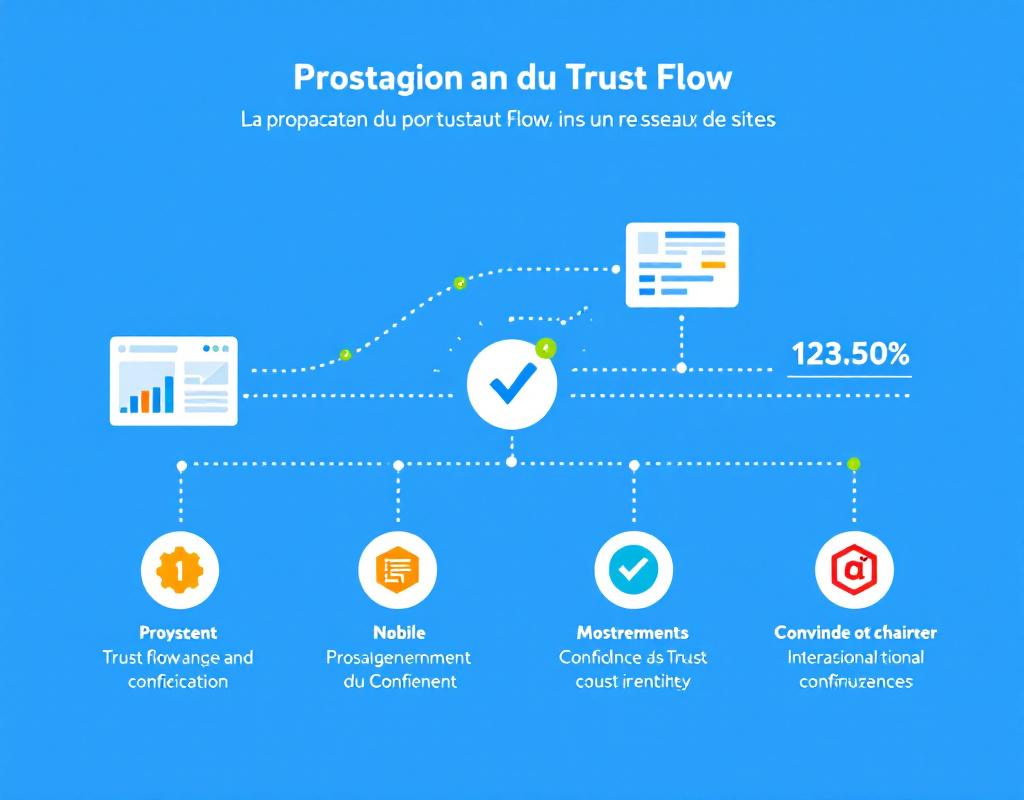
Visually, one can imagine a network of nodes: each reliable site distributes some of its “SEO juice” to the pages it mentions. If you receive a link from the World Bank, your page immediately gains trust points, unlike a site with a dubious profile. This representation clarifies the propagation logic: Trust Flow does not just count links, it wants to know who is talking about you.
Origin and Calculation Methodology
Building the Source Corpus
Majestic builds its site index and organizes domains into thematic clusters. The initial selection, sometimes called “seed sites,” defines a perimeter of reliable references (universities, public institutions, recognized media). Each newly crawled site is evaluated against these clusters: the more backlinks it receives from authorized roots, the higher its Trust Flow climbs.
Trust Transfer and Filtering
The value passed by a link is not uniform. Majestic applies a corrective coefficient according to the theme, the depth of the link (a homepage weighs more), and the semantic context. A link placed in an in-depth article will have more impact than a simple footer link. One perceives an attempt to adhere to the notion of relevance, even if, in practice, some niches benefit from automated optimizations to artificially boost their scores.
Controversies and Limits of Trust Flow
Reliability in the Face of Regular Updates
Several SEO campaigns report sharp variations in Trust Flow following updates to the Majestic index. A site can drop from 30 to 18 overnight, without any new action on its part. For a marketing manager, these fluctuations sow doubt: is it a faithful reflection of online reputation or an algorithmic artifact?
Perverse Effects on Link Building Strategies
The hunt for high Trust Flow links sometimes encourages borderline practices: massive purchases of links on private networks or multiplication of satellite sites to transmit fake authority. Tools such as Majestic SEO facilitate this race, but the real quality of backlinks can remain very relative, especially when the main criterion becomes the score rather than editorial relevance.
« We do not measure a link, we measure all the links that connect you to a trusted ecosystem. » – Anne Leclerc, SEO consultant.
Integrating Trust Flow into Your SEO Strategy
Prioritize Quality Link Building
Develop a link profile where each acquisition responds to a clear editorial logic. Rather than multiplying links, seek to collaborate with sites aligned with your theme. Some suggestions:
- Writing guest articles on authoritative blogs, with real added value.
- Thematic partnerships: case studies, co-produced infographics.
- Monitoring unlinked mentions (brand mentions) and converting them into backlinks.
These practices strengthen Trust Flow without triggering anti-spam algorithm alarms.
Monitoring, Auditing, and Adjustments
A quarterly audit allows you to identify toxic or inactive links. Use filters to isolate those whose Trust Flow is significantly lower than your average: they may harm your overall reputation. The goal is not to reach a maximum score, but to maintain a stable and upward curve over the long term.
Alternatives and Complementary Metrics
Citation Flow and Ratios
Citation Flow remains useful for evaluating link volume. A Trust Flow/Citation Flow ratio above 0.5 generally indicates a balanced profile: fewer links, but better chosen. Below that, there is a risk of inflation of less credible links. This quick comparison helps you calibrate your efforts.
Domain Authority, TrustRank, and Beyond
Among competing indicators, Moz’s Domain Authority or Google’s TrustRank offer a different perspective. Each relies on distinct databases and varied analysis logics. Using several metrics simultaneously reduces the bias of one or the other, offering a finer view of your online authority.
Critical Perspective: Myth or Reality?
Trust Flow is not a chimera, but one tool among others, with its strengths and blind spots. While it remains valuable for discriminating backlink quality, it will not be enough to make any site indispensable. The inherent fluctuations due to indexing and possible workarounds encourage not taking it as an oracle. Rather than an end in itself, consider it as a marker of the relevance and solidity of your link building strategy.
FAQ
What is Trust Flow ?
Trust Flow is a score from 0 to 100 developed by Majestic, which measures the trust a site receives from inbound links deemed to be of quality.
How is Trust Flow calculated ?
It is based on a network of trusted sources, called seed sites, and on the editorial and thematic quality of the backlinks passed on.
Is Trust Flow reliable ?
Reliable for distinguishing large volumes of useless links, it nevertheless suffers from variations related to updates and manipulation attempts.
Can we do without Trust Flow ?
It can be combined with other indicators (Citation Flow, Domain Authority) to obtain a more complete view of a site’s authority.