
| Key points | Details to remember |
|---|---|
| 🔍 Definition | GenMirror is a virtual mirror that replicates your work environments in real time. |
| ⚙️ Features | Continuous synchronization, version management, and automatic failover in case of failure. |
| 📊 Performance | Reduced latency thanks to network optimization and intelligent caching. |
| 🔒 Security | AES-256 encryption and granular access control. |
| 💰 Pricing | Flexible plans based on volume and SLA. |
| 💡 Use cases | Scalability testing, cloud migrations, or disaster recovery. |
Faced with the proliferation of virtual mirror platforms, it can sometimes be confusing to distinguish between marketing promises and technical reality. GenMirror, often highlighted for its robustness, is however not alone in this segment. This article offers an in-depth dive into the world of competing solutions to analyze performance, pricing, security, and adaptability. The goal: to guide you towards the tool that will truly optimize your business processes without surprises.
Somaire
Understanding the concept of a virtual mirror
A virtual mirror replicates an infrastructure—servers, databases, application content—in a parallel environment. Like a mirror in real life, every change on the main instance is instantly reflected on the copy. This technology proves valuable for:
- testing updates without impacting production;
- quickly switching over in case of critical failure;
- conducting load or intrusion simulations.
Although several players offer similar features, the quality of synchronization, the granularity of security options, and the cost-to-performance ratio vary significantly.
Presentation of GenMirror
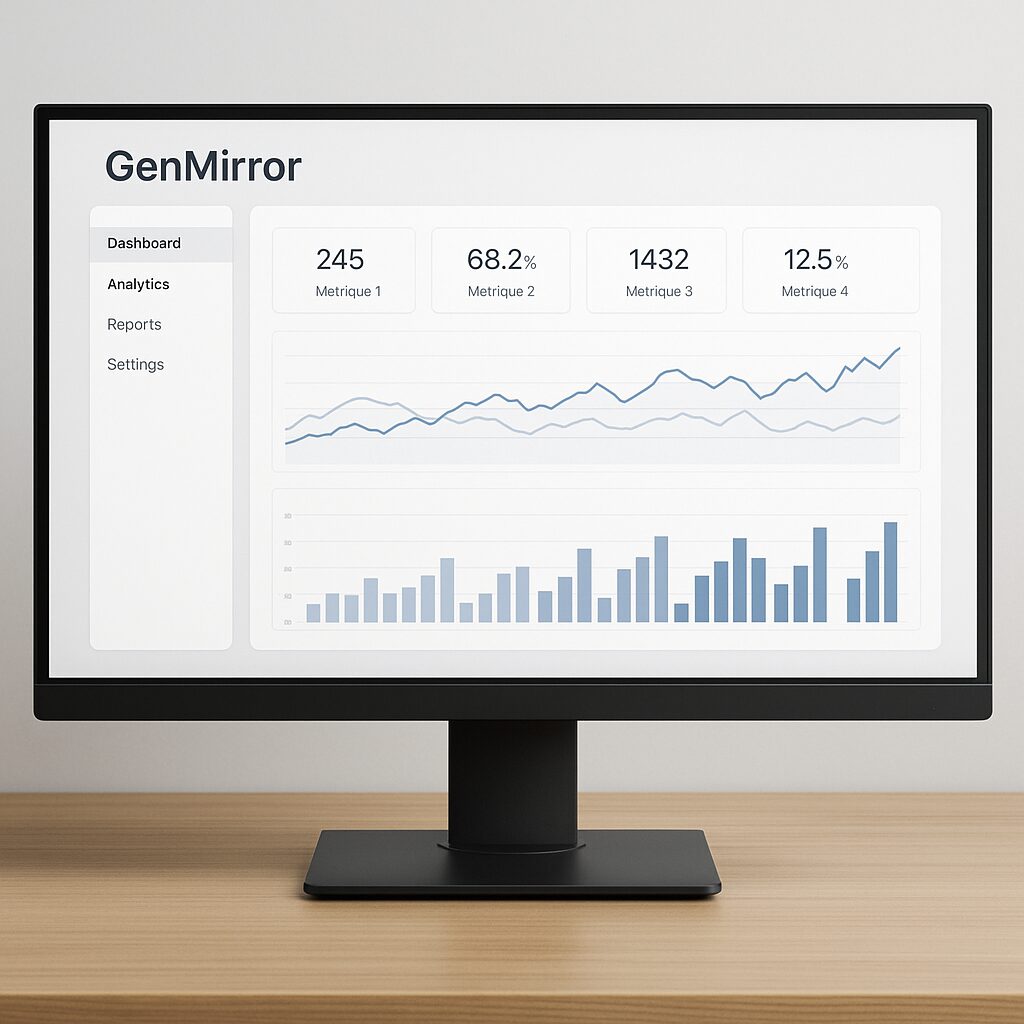
GenMirror stands out with an interface that is both sleek and rich in indicators. It features a dynamic dashboard offering an overview of replication rates, write and read throughput, as well as configurable alerts. The developer focused on:
- a centralized console compatible with multi-cloud;
- a differential replication engine to reduce network impact;
- REST APIs to automate orchestration with your DevOps scripts.
In practice, an administrator can schedule a failover window and test each component without interrupting users. The icing on the cake: a dedicated reporting section generates a summary PDF in just a few clicks, useful for your steering committees.
Alternatives and competing solutions
On the market, three main players compete with GenMirror: MiroirX, VirtuReflect, and MirrorCloud. Each showcases its strengths, sometimes complementary, sometimes direct competitors.
MiroirX
MiroirX focuses on database replication. Its strong point lies in native support for SQL and NoSQL DBMS, including PostgreSQL, MySQL, MongoDB, and Cassandra. We particularly appreciate:
“synchronization at the file-level or transaction-level, depending on coherence needs.”
- Minimization of I/O through optimized journaling;
- Multi-region replication with tolerance to partial network failures;
- customizable dashboards via drag & drop widgets.
VirtuReflect
If your priority is data protection, VirtuReflect offers “zero-knowledge” encryption: the keys remain under your control, with no management on the provider side. Notable features include:
- a requirement for two-factor authentication to access snapshots;
- an optional “air-gap” architecture to completely isolate the mirror environment;
- limited compatibility to standard Windows and Linux environments.
Its web interface, more minimalist than GenMirror’s, is aimed rather at companies for whom confidentiality outweighs API diversity.
MirrorCloud
MirrorCloud adopts a SaaS approach, ideal for small and medium businesses without a dedicated DevOps team. Its selling point? Guided assistants and pre-configured templates to copy a website or a complete application environment in just a few clicks.
- agentless installation based on cloud-init scripts;
- integrated monitoring service, with logs exportable to your SIEM;
- all-inclusive pricing plans, with no surprise network surcharge fees.
However, customization remains limited and MirrorCloud can show its limits once you move beyond standard use cases.
Essential comparison criteria
Before deciding, it is advisable to evaluate each solution according to several axes:
- Performance – replication latency, bandwidth used;
- Security – encryption, access, audits, and compliance;
- Interoperability – OS compatibility, cloud support, APIs;
- Cost – pricing model, hidden fees, licensing;
- User experience – ergonomics, logs, reporting.
In terms of network security and anonymization, there are also similar challenges to those encountered in our study on the reliability of free VPNs, since the confidentiality of replicas often goes beyond the simple question of encryption.
Case Study: How to Make the Right Choice
Imagine a fintech subject to regular audits and eager to scale without latency: VirtuReflect, with its enhanced encryption, proves to be wise. On the other hand, for a web host that needs to multiply testing environments, MirrorCloud turns out to be more economical and faster to deploy.
In an agile development context, GenMirror will find its place thanks to its APIs and modular dashboard, notably for:
- synchronous replication for pre-production environments;
- continuous integration scripts triggered after each build;
- failover time reporting in third-party dashboards.
For a hybrid structure, mixing public cloud and on-premise servers, MiroirX can be integrated with your Kubernetes orchestrator, while MirrorCloud is limited to the cloud.
FAQ
- What is a virtual mirror and why use it?
A virtual mirror replicates your infrastructure in parallel to test, secure, or ensure business continuity without interrupting production services. - Is GenMirror suitable for small businesses?
Yes, its modular packages and intuitive interface adapt well to both very small businesses and large enterprises. - How to measure replication latency?
It is generally calculated as the time between writing in the main environment and its appearance in the mirror, measured in milliseconds. - Does encryption affect performance?
AES-256 encryption adds a slight overhead, but deferred engines and smart caching significantly limit the impact. - Can multiple solutions be combined?
In practice, GenMirror can be coupled for critical environments and MirrorCloud for light testing, provided each workflow is finely orchestrated.