| Key Points | Details to Remember |
|---|---|
| 🕹️ Definition | Emulate the hardware of classic consoles via programmable circuits |
| ⚙️ Operation | Reproduce the original logical and electronic behaviors |
| 🎯 Accuracy | Minimize latency and synchronization errors |
| 🎮 Compatibility | Support multiple architectures of historical consoles |
| 📦 Preservation | Protect video game heritage in the long term |
| 🚀 Performance | Offer a smooth and faithful experience to the original gameplay |
FPGA emulation closely reproduces the hardware behavior of vintage consoles, eliminating latency and software approximations. By using programmable logic circuits, it guarantees compatibility and fidelity impossible to achieve by software alone. The result: an authentic gaming experience, identical to the original machines.
Somaire
Foundations of FPGA Emulation
Behind every FPGA project lies the desire to recreate the electronic circuit at the gate-by-gate scale. This hardware approach allows bypassing software layers and offers an almost perfect reproduction of the behavior of classic consoles.
What is an FPGA?
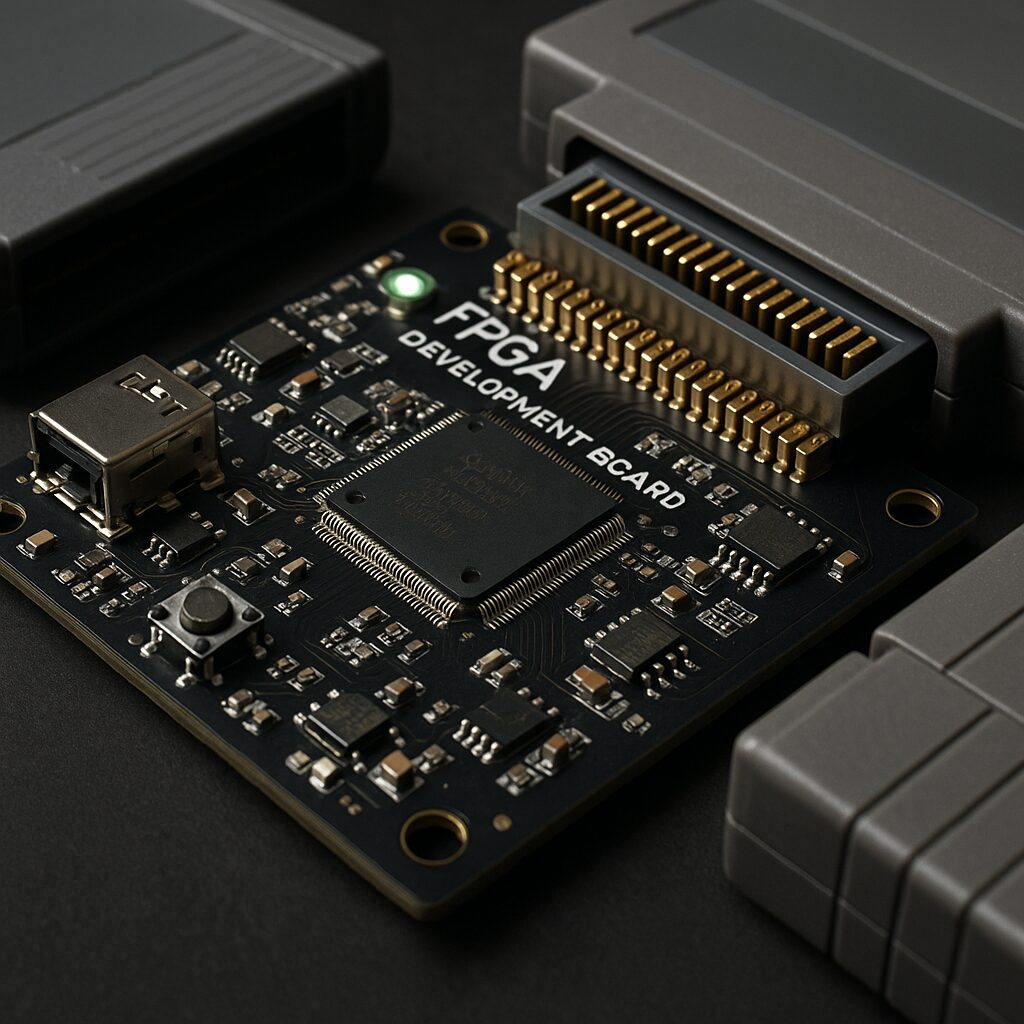
An FPGA (Field-Programmable Gate Array) is a chip composed of thousands of configurable logic blocks. Unlike a generic microprocessor, each block can be wired to mimic a specific circuit, for example that of a 6502 processor or a graphics chipset from the 1980s.
Advantage over software emulation
- Near-zero latency: electronic signals flow directly within the FPGA without passing through an OS layer.
- Precise synchronization: every clock and register is recreated identically.
- Hardware compatibility: peripherals (controllers, cartridges) interact as on the original console.
“With an FPGA, you no longer simulate the console: you rebuild it bit by bit.” – A retrogaming engineer
Concrete benefits for players
Beyond the technology, FPGA emulation transforms the gaming experience for enthusiasts and video game heritage conservators. Here are the major advantages that captivate the community.
Precision and Responsiveness
Each frame is generated within the cycles specified by the original specifications, which eliminates stuttering, irregular “framepacing,” or the usual image correction. The transition from the image to the screen happens almost instantly, even with a modern display.
Multi-console Compatibility
Some open source projects such as MiSTer or commercial products like the Analogue Pocket integrate several FPGA “cores,” each recreating a different console: NES, SNES, PlayStation 1, etc. Switching from one platform to another occurs without software overhead or latency.
Integration into the Retrogaming Ecosystem
The market is organized around turnkey solutions and DIY kits, which democratizes access to this technology once reserved for engineers.
| Solution | Indicative Price | Covered Consoles |
|---|---|---|
| MiSTer FPGA | €200–300* | Arcade, NES, Mega Drive, Neo Geo… |
| Analogue Pocket | €220 | Game Boy, Game Boy Color, Game Boy Advance |
| Cotton Candy DIY | Variable | Amiga, Atari, ZX Spectrum (via third-party cores) |
* Excluding costs of SDRAM modules and additional adapters.
Challenges and Perspectives
FPGA emulation is not just a gadget for nostalgics: it paves the way for durable preservation of hardware code and offers a basis for studying and restoring lost prototypes.
Preservation of Video Game Heritage
Original components age and become irreparable. By describing each logic gate in a configuration file, an immutable “master” is created, indifferent to the obsolescence of silicon.
Future Technological Evolutions
The next generations of FPGAs will offer more embedded memory and advanced DSP blocks, allowing emulation of complex 3D consoles at higher frequencies, or even support for modern rendering while keeping the original “feel.”
FAQ
What is an FPGA and how does it differ from a software emulator?
An FPGA recreates the electronic circuit at the hardware level, whereas software emulation interprets the operation via code on CPU/GPU, with timing approximations.
What impact does latency have on the retrogaming experience?
Reduced latency enhances gameplay precision, essential for action or rhythm games where every millisecond counts.
Which projects or products use FPGA emulation today?
MiSTer FPGA, Analogue Pocket, RetroFreak, and several DIY kits are among the most popular currently.
Does FPGA emulation support all classic consoles?
It covers the vast majority of 8- and 16-bit consoles and is progressively extending to 32/64-bit architectures depending on FPGA chip power.
How does FPGA emulation contribute to the preservation of video game heritage?
By storing the hardware description of consoles in digital form, it ensures the ability to recreate these machines even when components disappear.
What are the current challenges and limitations of this technology?
The cost of FPGAs and the complexity of developing new cores remain high, sometimes hindering independent projects.
What future is shaping for FPGA emulation in retrogaming?
More powerful FPGAs will soon allow emulation of 3D consoles without compromise and exploration of new forms of retro-modern interactivity.
{
“@context”: “https://schema.org”,
“@type”: “WebPage”,
“about”: {
“@type”: “Thing”,
“name”: “FPGA Emulation for Retrogaming”
},
“keywords”: [“FPGA”, “retrogaming”, “emulation”, “classic consoles”, “heritage”]
}
{
“@context”: “https://schema.org”,
“@type”: “Article”,
“headline”: “Retrogaming: Why is FPGA Emulation the Future of Classic Consoles?”,
“description”: “Dive into the world of retrogaming and discover how FPGA emulation faithfully reproduces classic consoles, minimizes latency, and preserves video game heritage.”,
“keywords”: [“FPGA emulation”, “retrogaming”, “classic consoles”],
“mainEntity”: {
“@type”: “FAQPage”,
“mainEntity”: [
{
“@type”: “Question”,
“name”: “What is an FPGA and how does it differ from a software emulator?”,
“acceptedAnswer”: {
“@type”: “Answer”,
“text”: “An FPGA recreates the electronic circuit at the hardware level, whereas software emulation interprets the operation via code on CPU/GPU, with timing approximations.”
}
},
{
“@type”: “Question”,
“name”: “What impact does latency have on the retrogaming experience?”,
“acceptedAnswer”: {
“@type”: “Answer”,
“text”: “Reduced latency enhances gameplay precision, essential for action or rhythm games where every millisecond counts.”
}
},
{
“@type”: “Question”,
“name”: “Which projects or products currently use FPGA emulation?”,
“acceptedAnswer”: {
“@type”: “Answer”,
“text”: “MiSTer FPGA, Analogue Pocket, RetroFreak, and several DIY kits are among the most popular at the moment.”
}
},
{
“@type”: “Question”,
“name”: “Does FPGA emulation support all classic consoles?”,
“acceptedAnswer”: {
“@type”: “Answer”,
“text”: “It covers the vast majority of 8- and 16-bit consoles and is gradually extending to 32/64-bit architectures depending on the power of the FPGA chips.”
}
},
{
“@type”: “Question”,
“name”: “How does FPGA emulation contribute to the preservation of video game heritage?”,
“acceptedAnswer”: {
“@type”: “Answer”,
“text”: “By storing the hardware description of consoles in digital form, it ensures the ability to recreate these machines even when components disappear.”
}
},
{
“@type”: “Question”,
“name”: “What are the current challenges and limitations of this technology?”,
“acceptedAnswer”: {
“@type”: “Answer”,
“text”: “The cost of FPGA and the complexity of developing new cores remain high, sometimes hindering independent projects.”
}
},
{
“@type”: “Question”,
“name”: “What future lies ahead for FPGA emulation in retrogaming?”,
“acceptedAnswer”: {
“@type”: “Answer”,
“text”: “More powerful FPGAs will soon allow emulating 3D consoles without compromise and exploring new forms of retro-modern interactivity.”
}
}
]
}
}