
| Key Points | Details to Remember |
|---|---|
| 📐 Definition of Trust Flow | Measure of credibility based on backlink quality |
| ⚖️ Importance for SEO | Direct impact on visibility and search engine trust |
| 🔗 Backlink Analysis | Identification of toxic links and opportunities |
| 🛠️ Estimation Tool | Majestic, Ahrefs, SEMrush, and alternatives |
| 🚀 Growth Strategies | Acquisition of quality links and partnerships |
| 📊 Monitoring and Reporting | Dashboards to track your progress |
Trust Flow, an indicator designed to evaluate the reliability of a website, establishes itself as an essential barometer in link building. It is no longer enough to accumulate links: their origin, authority, and context make the difference. In this guide, we thoroughly examine ten essential tools to precisely measure your Trust Flow and deploy effective strategies to boost it.
Somaire
Why is Trust Flow so decisive?
At a time when Google constantly refines its algorithms, the mere quantity of backlinks no longer guarantees much. Trust Flow, created by Majestic, weights each link according to the reliability of the host domain. This can be compared to the reputation of an academic author: citing a recognized expert is worth much more than multiplying mentions in lesser publications.
Indeed, several debates animate the SEO sphere, sometimes referred to as SEO controversies, around the real influence of this metric. Nevertheless, Majestic’s internal studies reveal a strong correlation between high Trust Flow and ranking on competitive queries.
The criteria that influence your Trust Flow
Behind the numerical score lie several dimensions to scrutinize:
- Quality of referring domains: authority, theme, and history.
- Anchors: semantic relevance and diversification of texts.
- Contextualization: links inserted in rich and coherent content.
- IP profile: exclusive networks and geographic distribution.
Understanding these levers helps avoid penalties and target niches where competition struggles to establish strong credibility.
10 essential tools to analyze and increase your Trust Flow
1. Majestic
Essential, Majestic remains the reference for checking your Trust Flow in real time. The interface offers two complementary metrics: Trust Flow and Citation Flow. The first reflects quality, the second the quantity of incoming links.
- View the “Topical Trust Flow” to determine your thematic levers.
- Identify toxic backlinks to disavow with the integrated disavow tool.
- Use the Site Explorer to analyze each URL in depth.
To fully master all these features, consult the ultimate Majestic SEO guide which provides step-by-step implementation of each module.
2. Ahrefs
Although Ahrefs does not directly calculate Trust Flow, its “Domain Rating” (DR) and “URL Rating” (UR) offer a reliable estimate of your pages’ authority. Ahrefs stands out for:
- Its daily crawl, ensuring fresh data.
- The “dofollow” vs “nofollow” filter to segment links.
- The backlink growth graph to visualize your progress over several months.
Integrate these indicators into your monthly audits to keep a precise eye on the evolution of your link profile.
3. SEMrush
Beyond its powerful SEO functions, SEMrush includes a “Backlink Audit” module coupled with a “Link Building Tool.” Its asset: a very visual interface where healthy and risky links are categorized at a glance.
The recommendation engine even suggests domains to contact, classified by theme and authority. A valuable time saver when you set up a systematic outreach campaign.
4. LinkResearchTools
For sites with a strong history or penalties to clear, LinkResearchTools (LRT) deploys “Penalized and Negative SEO Protection.” You can:
“Isolate networks of fake sites and play offense thanks to a comprehensive disavow report.”
LRT also offers a “Competitive Link Velocity Checker” to evaluate your competitors’ link building pace and derive strategy.
5. Monitor Backlinks
Designed for SMEs as well as freelancers, Monitor Backlinks emphasizes ease of use:
- Email alerts for each new or lost link.
- Anchor text analysis and segmentation by campaign.
- Estimated Trust Flow evaluation based on the Majestic API.
A clear dashboard helps you quickly decide whether to keep, improve, or disavow a problematic link.
6. CognitiveSEO
CognitiveSEO offers a very advanced “Unnatural Link Detection.” The platform combines:
- Semantic analysis of host pages.
- Mapping of private blog networks (PBN).
- Evaluation of acquisition speed to detect anomalies.
Its integration with Google Analytics allows cross-referencing traffic and Trust Flow, to isolate backlinks that truly generate qualified traffic.
7. OpenLinkProfiler
Completely free, OpenLinkProfiler scans up to one million backlinks per domain. Its strengths:
- Date filtering to track recent links.
- CSV export for customized processing.
- Freshness index to distinguish obsolete links.
Ideal as a complement to paid tools, it provides a broad view without straining your SEO budget.
8. Moz Link Explorer
Moz offers its own “Domain Authority” (DA) and “Spam Score.” Although they differ from Trust Flow, these metrics often correlate:
- DA > 50: strong trust factor.
- Spam Score > 7: caution required.
- Link opportunities identified via “Link Intersect.”
Use Moz to complement your link mapping, especially in English-speaking niches where Majestic is sometimes less comprehensive.
9. SEO PowerSuite
Publisher of four desktop software programs, SEO PowerSuite provides offline link management:
- Rank Tracker: correlates TF and ranking.
- WebSite Auditor: identifies pages to strengthen.
- SEO SpyGlass: analyzes over 100 backlink sources.
- LinkAssistant: tracks your outreach campaigns.
One of its strengths is the ability to work offline, convenient when traveling or on field missions.
10. Google Search Console
Finally, Google’s Search Console displays your most significant links. Although it does not detail Trust Flow, it reveals:
- Most active referring domains.
- Most cited destination URLs.
- Periods of link appearance and disappearance.
Cross-reference this data with Majestic to differentiate backlinks that enhance your TF from those that have little weight or generate unqualified traffic.
Methods to strengthen your Trust Flow
Accumulating links without strategy is not enough. Here are some concrete approaches:
- Targeted guest blogging on sites with strong thematic authority.
- Infographics and original studies, true link magnets.
- Partnerships with universities, associations, or recognized blogs.
- Monitoring to detect unlinked mentions and turn them into backlinks.
Each link obtained through rich and contextual content not only strengthens your Trust Flow but also your reputation as a reference.
Monitoring and reporting
Without continuous measurement, it is difficult to know if your actions are bearing fruit. Implement:
- A monthly dashboard in Google Data Studio.
- Alerts for your Trust Flow < 0.5 points monthly.
- Quarterly reviews combining TF and organic traffic.
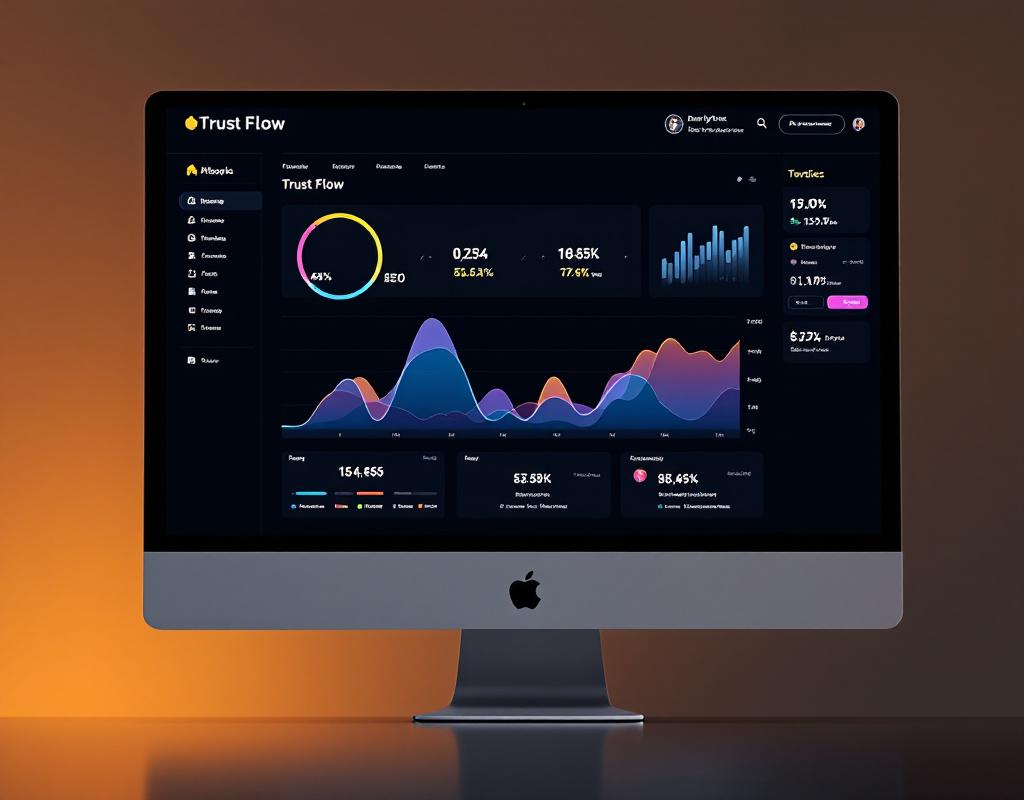
This integrated visual allows you to anticipate drops and adjust your link-building campaigns before the impact becomes visible on your rankings.
FAQ
What is Trust Flow?
Trust Flow evaluates a site’s trustworthiness by analyzing the quality of its backlinks. The more your links come from reputable domains, the higher your TF increases.
How does Citation Flow differ from Trust Flow?
Citation Flow measures only the quantity of backlinks, while Trust Flow weighs their quality. The balance between the two signals a natural link profile.
Are there free tools to analyze Trust Flow?
OpenLinkProfiler and Google’s Search Console are good no-cost options. They provide an overview of your backlinks and their freshness.
What strategy should be favored to quickly increase Trust Flow?
Favor creating high-value content and partnerships with reference sites, rather than spamming low-authority links.