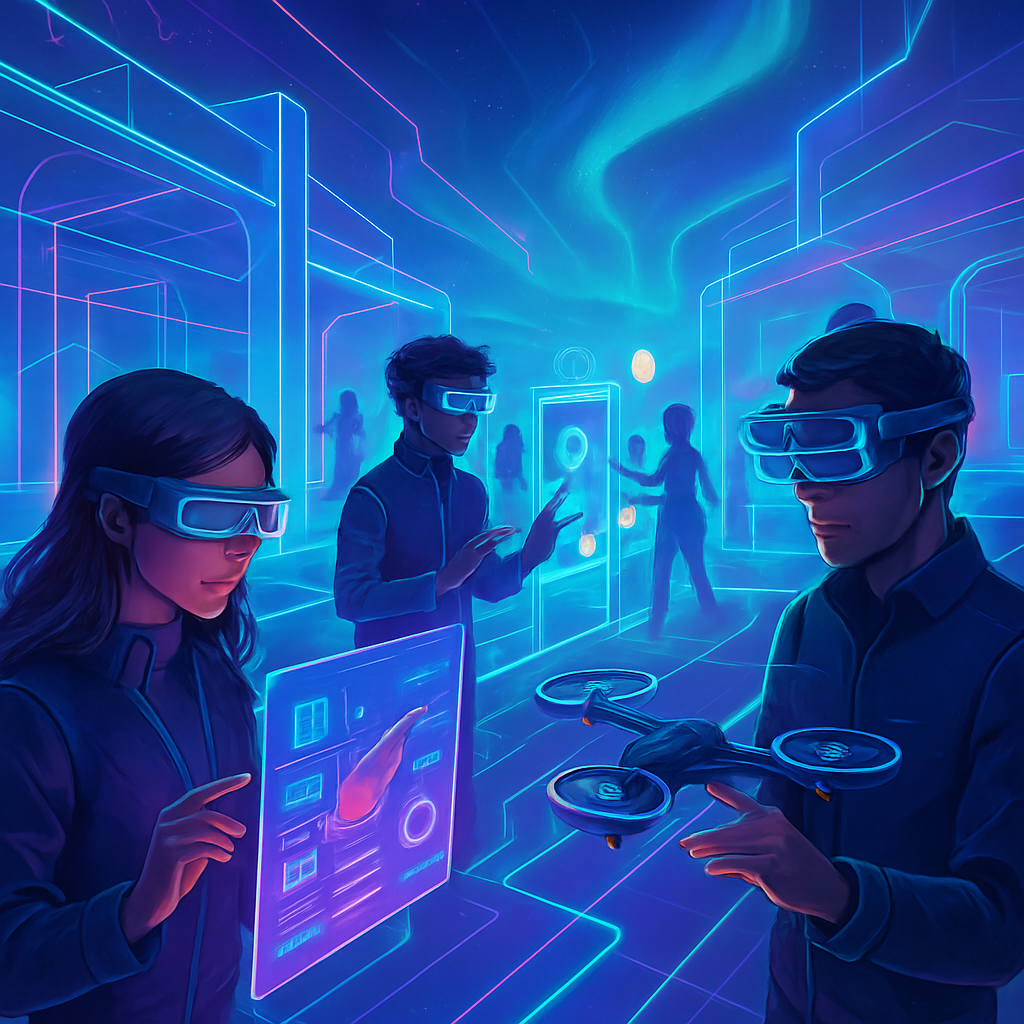
The metaverse landscape is fragmenting between proprietary platforms and open initiatives; this article takes stock of open source projects aiming to decentralize the immersive experience. Rather than providing an exhaustive list, I analyze architectures, protocols, economic models, and technical barriers to help the reader identify truly decentralized approaches — those that can be cloned, hosted, and evolved collectively.
Somaire
In brief
🤝 Key concept: a decentralized metaverse combines open 3D formats (glTF), identity protocols (DID), distributed storage (IPFS/Filecoin), and sometimes blockchains for ownership.
🔎 Relevant projects: Mozilla Hubs, Decentraland (open source components), OpenSimulator, and JanusWeb offer varying levels of decentralization and self-hosting.
⚙️ Interoperability: OpenXR/WebXR and glTF formats facilitate asset reuse; DIDs and token standards (ERC-721/1155) serve identity and object portability.
🛠️ For developers: prioritizing Web stacks (A-Frame/Three.js), asset management via IPFS, and decentralized identity services accelerates a truly distributed architecture.
Why open source is essential to the decentralized metaverse
One might think decentralization boils down to “putting everything on a blockchain.” That would be reductive. Decentralization implies the ability to clone, host, and evolve the code, to carry your assets and identity between worlds, and to avoid proprietary locks. Open source provides this transparency: auditing 3D rendering, understanding how ownership rights are recorded, or deploying your own social server. Without open code and shared standards, the metaverse remains fragmented and captive.
Architecture and recurring components
Asset formats and rendering
Open projects rely heavily on glTF for 3D models: lightweight, optimized for the web, and supported by an ecosystem of tools. Rendering is done through JavaScript engines (Three.js, Babylon.js) or WebXR/A-Frame frameworks for VR access directly from the browser. This web orientation lowers the entry barrier and enables interoperability between clients.
Storage and distribution
Storing textures, scenes, and assets on a centralized CDN contradicts the decentralized spirit. Popular solutions are IPFS and Filecoin: IPFS distributes content by hash and Filecoin offers incentivized storage. Practically, hosting a world often involves a combination: versioning and distribution via IPFS, metadata and transactions via blockchain, caches for latency.
Identity and Ownership
Serious projects integrate DIDs and credential standards so that identity does not depend on a single provider. For ownership of digital objects, using ERC-721/1155 or equivalents allows portability — when the rest of the infrastructure supports these standards. Without transferable identity mechanisms, ownership remains captive to a centralized service.
Overview of Open Source Projects
Here are four representative projects, chosen for their distinct approaches: lightweight social, blockchain-based world, self-hosted server, and native web.
| Project | Orientation | Open source | Practical decentralization | Strengths |
|---|---|---|---|---|
| Mozilla Hubs | Browser-based social spaces | Yes (public code) | Self-hosting possible, partial federation | Immediate access via browser, WebXR, simplicity for events |
| Decentraland (components) | Persistent parcels + blockchain | Client and SDK available | Ownership via smart contracts (Ethereum/sidechains) | Land and asset economy, tool community |
| OpenSimulator | Self-hosted servers (inspired by Second Life) | Yes | High: fully controllable private servers | Server customization, compatibility with existing viewers |
| JanusWeb / JanusXR | Web-centric, 3D hypertext | Yes | Low to medium — based on distributed web hosting | Logical linking between 3D pages, native web protocols |
Comparative Observations
Mozilla Hubs favors immediate experience and modularity: any visitor can join a world without installation. OpenSimulator offers total control but requires server administration. Decentraland places economy and scarcity at the heart of the model, which leads to sometimes costly technical choices (blockchain). JanusWeb experiments with web/3D fusion, useful for hyperlinked architectures where each scene is a URL.
Interoperability: Formats, Standards, and Limits
For an object or avatar to cross worlds, three things are needed: an asset format understood by each client (glTF), an identity representation (DID), and a registry for ownership (blockchain or distributed service). OpenXR/WebXR standards guarantee a consistent low-level layer for VR/AR rendering. However, interoperability often stops at assets: game logic, proprietary scripts, and behaviors remain difficult to port without common specifications.
- Technical strengths: glTF, WebXR, DIDs facilitate portability.
- Current bottlenecks: lack of standards for object scripts, differences in economic policies, network latencies.
- Paths forward: define execution sandboxes for scripts and standardize asset metadata.
Concrete Use Cases and Feedback
Professional events use Hubs for its simplicity: an immersive meeting in a few clicks without complex asset management. Educational communities use OpenSimulator to control the environment and preserve data. Digital art marketplaces benefit from the Decentraland + IPFS combination for public display and proof of ownership. These uses show that there is no “best” project: the choice depends on the desired balance between control, cost, and interoperability.
Practical Recommendations for Building an Open Metaverse
If the goal is to launch a truly decentralized space, here is a pragmatic roadmap:
- Adopt glTF for all 3D assets and define a shared metadata schema (license, author, version).
- Store files on IPFS and keep mirrors for availability.
- Manage identity and permissions via DIDs and Verifiable Credentials rather than centralized accounts.
- Use Web standards (WebXR/OpenXR) to broaden multi-device access.
- Document and version APIs: open source is only useful if the community can reuse the code.

The visual above illustrates the layering: client-side 3D rendering, distributed asset storage, and property/identity layer managed by decentralized registries. This setup synthesizes a viable architecture for immersive experiences that remain controllable by their communities.
Economic Challenges and Sustainable Models
Funding an open metaverse requires thinking beyond captive subscriptions. Observed models include commissions on asset sales, crowdfunding for protocol development, sponsored hosting, or premium services (administration tools, analytics). Open source can coexist with monetization, but the challenge is not to turn the architecture into a mere showcase for proprietary services.
Perspectives: Towards a Federation of Spaces
The most convincing trajectory is not a single global universe but a federation of interoperable spaces: each community hosts its world, identities are portable, and standard ports allow the crossing of objects and avatars. To achieve this, two projects are priorities: standardizing script execution and defining trust bridges between property registries.
FAQ
What distinguishes a “decentralized” metaverse from a simple multiplayer world?
A multiplayer world can be hosted by a single entity; decentralization means that the code, data, and property can be replicated, controlled by multiple actors, and moved between environments without depending on a single provider.
Can you have a high-performance immersive experience while remaining decentralized?
Yes, but it requires technical compromises: local caches to reduce latency, distribution networks for assets, and hybrid architectures (some centralized services for performance, main distributed storage). Advances in WebXR and edge computing reduce the gap.
Is a blockchain necessary to create a decentralized metaverse?
Not necessarily. Blockchain excels for proof of ownership and value transfers. For content distribution and identity, IPFS and DIDs may suffice. The best choice depends on the need for scarcity and native economy.
How to quickly start an open source prototype?
Choose Hubs or JanusWeb for rapid prototyping, package glTF assets, host on IPFS, and test authentication via a simple DID. The important thing is to document the API from the start to invite other developers to contribute.
Conclusion
The decentralized metaverse is under construction: technical foundations exist (glTF, WebXR, IPFS, DIDs) and open source projects demonstrate the feasibility of self-hosted or federated worlds. The real challenge remains the harmonization of standards so that identity and objects can travel without friction. For communities and developers, the immediate priority is pragmatic: favor open formats, store in a distributed manner, and document the API — this is how spaces truly controlled by their users will be born.
{
“@context”: “https://schema.org”,
“@type”: “WebPage”,
“about”: {
“@type”: “Thing”,
“name”: “Open Source Decentralized Metaverse”
},
“keywords”: [“decentralized metaverse”, “open source”, “interoperability”, “protocols”, “web3”]
}