| Key Points | Details to Remember |
|---|---|
| 🔍 Definition | Choose a board according to the intended use |
| ⚡ Performance | Evaluate frequency and number of LUTs |
| 💰 Price | Compare cost/performance ratio |
| 🔗 Compatibility | Check tool support |
| 🛠️ Ecosystem | Analyze the richness of libraries |
| 🎮 Applications | Adapt to the desired type of emulation |
This guide compares in detail several popular FPGA boards for emulation, based on criteria of performance, price, and software compatibility. You will find quantified analyses, user feedback, and summary tables to facilitate your choice.
Somaire
1. Understanding the Role of an FPGA Board in Emulation
An FPGA (Field-Programmable Gate Array) board allows recreating the hardware behavior of consoles, audio circuits, or peripherals. Unlike software solutions, FPGA emulation offers cycle-accurate precision and minimal latency, crucial for purists.
1.1 What is an FPGA?
An FPGA is a reconfigurable logic circuit on the fly. Logical blocks and interconnections are programmed to reproduce the internal operation of target hardware. This flexibility appeals both to retro-gaming enthusiasts and prototyping engineers.
1.2 Advantages of Hardware Emulation
- Accuracy: timings faithful to 100%.
- Reliability: absence of bugs introduced by software.
- Extensions: possibility to add new functions (overclocking, graphic filters).
2. Comparison Criteria
To evaluate each FPGA board, we retained three main axes: raw power, required budget, and compatibility with emulation tools such as MiSTer or Retrode-FPGA.
2.1 Performance and Logical Resources
The performance of an FPGA is mainly measured by the number of LUTs (Look-Up Tables) and maximum operating frequency. These two indicators directly affect the complexity of supported logic cores.
2.2 Price and Quality/Price Ratio
The cost of an FPGA board ranges from a few dozen to several hundred euros. We calculated a performance/price ratio for each model to guide limited budgets and enthusiasts ready to invest.
2.3 Software Compatibility
Some boards are natively supported by the MiSTer community, while others require adaptations. The availability of plugins and configuration guides is a decisive asset.
3. Detailed Comparison of Models
| FPGA Board | LUT | Frequency | Price (€) | Compatibility |
|---|---|---|---|---|
| Terasic DE10-Nano | 110 K | 100 MHz | 130 | Official MiSTer |
| Tang Nano 9K | 9,000 | 80 MHz | 25 | Open source |
| Arrow DECA | 142 K | 125 MHz | 200 | MiSTer & forks |
| Terasic DE10-Standard | 220 K | 156 MHz | 380 | Professional |
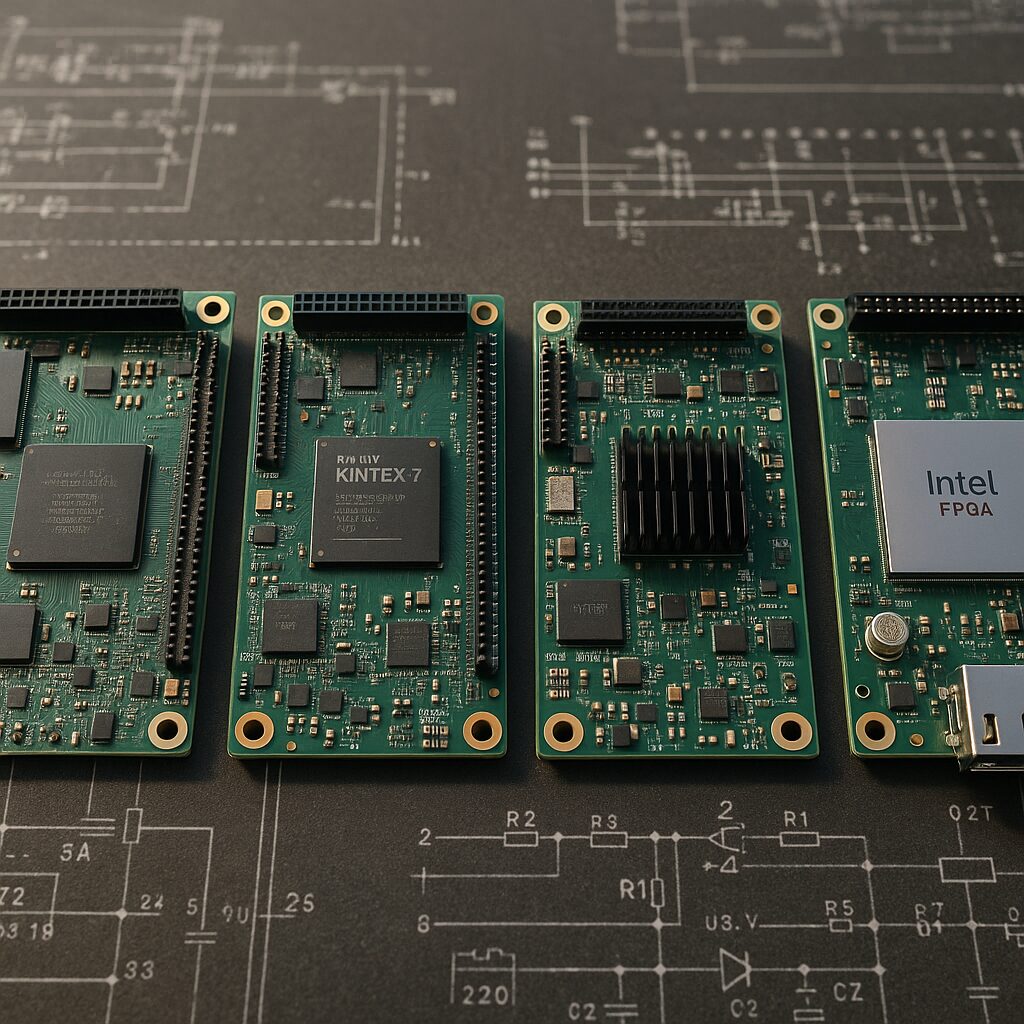
3.1 Terasic DE10-Nano
The DE10-Nano remains the reference in consumer emulation. Its Cyclone V FPGA offers a good balance between size and cost, with native support for the MiSTer distribution. Users appreciate the stability and rich documentation.
3.2 Tang Nano 9K
Entry-level, the Tang Nano 9K appeals with its low price. With only 9,000 LUTs, it mainly targets light or educational projects. The main drawback remains the limited frequency and the absence of dedicated audio/video connectors.
3.3 Arrow DECA
The DECA outperforms the DE10-Nano in number of LUTs and memory bandwidth. Ideal for advanced or multi-core projects, it remains more expensive and requires some expertise for initial configuration.
3.4 Terasic DE10-Standard
Designed for professional use, the DE10-Standard integrates a more generous FPGA and high-speed interfaces. For a high-resolution FPGA emulator or with multiple simultaneous cores, it is the most sustainable choice, despite a high cost.
4. Application Examples and Feedback
Several communities share their projects on GitHub or specialized forums. Examples include:
- A 16-bit console emulator with custom shader filters.
- A faithful replica of a vintage analog synthesizer.
- Prototypes of reversible USB controllers for retro-gaming.
« With the DE10-Nano, I recreated the Super NES audio chip without a single line of abstract Verilog code! » – FPGA enthusiast
5. Key Takeaways
- The DE10-Nano is equivalent to a standard for beginners.
- The Tang Nano 9K remains an economical option for small projects.
- The Arrow DECA combines performance and versatility for advanced hobbyists.
- The DE10-Standard targets professional uses and demanding setups.
- Always check software compatibility before purchase.
FAQ
- What budget should be planned for a decent FPGA board?
- Expect between €100 and €200 for a balanced mid-range board.
- Which board offers the best performance/price ratio?
- The DE10-Nano remains the optimal choice for consumer use, thanks to its MiSTer support and affordable price.
- Can a 32-bit console be emulated on a Tang Nano 9K?
- The limited number of LUTs and frequency make this operation very complex; it is better to aim for at least a DE10-Nano.
- Does power consumption vary much between models?
- Yes, the more powerful the chip, the higher the consumption. Expect 5 W for a 9K and up to 20 W for a DE10-Standard.
- Is the MiSTer community active?
- Extremely: updates, cores, plugins, and guides are regularly published on GitHub and Discord.