
| Key Points | Details to Remember |
|---|---|
| 🔍 Definition | Understanding the Trust Flow metric |
| 📊 Calculation | Analyzing the influence of incoming links |
| ⚖️ Importance | Evaluating backlink quality |
| 🔧 Tools | Using Majestic and alternatives |
| 🚀 Optimization | Strengthening the link profile |
| 📈 Monitoring | Measuring evolution over time |
Trust Flow embodies a trust metric that has revolutionized the way backlink profile quality is assessed. Rather than a simple count of links, it focuses on the reputation of referring sites. In the face of increasingly fierce competition, understanding and improving this score becomes a priority for anyone looking to strengthen their online visibility. This guide accompanies you step by step, from theoretical foundations to concrete actions to boost your Trust Flow.
Somaire
What is Trust Flow?
At the heart of the Majestic tool, Trust Flow quantifies the authority of a page based on the “trust” passed on by referring sites. The idea is not new: the principle is inspired by a reputation logic, where each link acts as a vote. However, not all these votes are equal. Those coming from “reliable” domains weigh more heavily in this calculation.
An important nuance: trust is not immediately calculable by a simple mathematical process. Majestic relies on a set of so-called “seed” sites (initial sources) manually validated. From this list, an algorithm explores the web, assigns a coefficient to each link, and extends the analysis in a cascading manner. The result: a score from 0 to 100, where a high Trust Flow reflects a web of links from reputable pages.
Origin and Methodology
Designed in the early 2010s, Trust Flow was a response to the limitations of existing metrics, often easily manipulated. The founders of Majestic defined a strict protocol for selecting initial sources, including notably institutional sites, academic publications, and platforms recognized for their editorial quality.
Then, the algorithm assigns an increasing weighting to “cascading” links: the more the path leading to your page passes through trusted sources, the higher your score climbs. This hierarchical approach prevents a mere torrent of low-value links from skewing the evaluation.
Why is Trust Flow essential?
Considered more representative of the health of a backlink profile, Trust Flow goes beyond the simple number of references. It is used to detect attempts of “link farming” and to prioritize links that will truly impact your SEO.
In practice, a low Trust Flow despite a large volume of backlinks immediately alerts to the presence of poor-quality links. Similarly, a rising score often signals that a site is part of a trusted link network, beneficial for ranking.
Comparison with Citation Flow
Citation Flow measures the quantity of links pointing to a page, without weighting. One might think that a high Citation Flow guarantees solid popularity, but in reality, it does not inform about the origin of these links.
By observing both metrics together, you get a clearer view: a high Citation Flow combined with a moderate Trust Flow can indicate an unbalanced profile; conversely, a strong Trust Flow despite a lower Citation Flow shows that few links, but of high quality, are enough to establish your authority.
How to analyze your backlink profile
Before engaging any strategy, a detailed audit phase is essential. The goal is to map all incoming links, isolate those that truly carry trust, and identify anomalies.
- Export the complete list of your backlinks via Majestic or another crawler.
- Sort by Trust Flow to identify the most valuable links.
- Identify domains with near-zero Trust Flow: these links can degrade the average.
- Note authoritative source pages and study their themes to validate coherence.
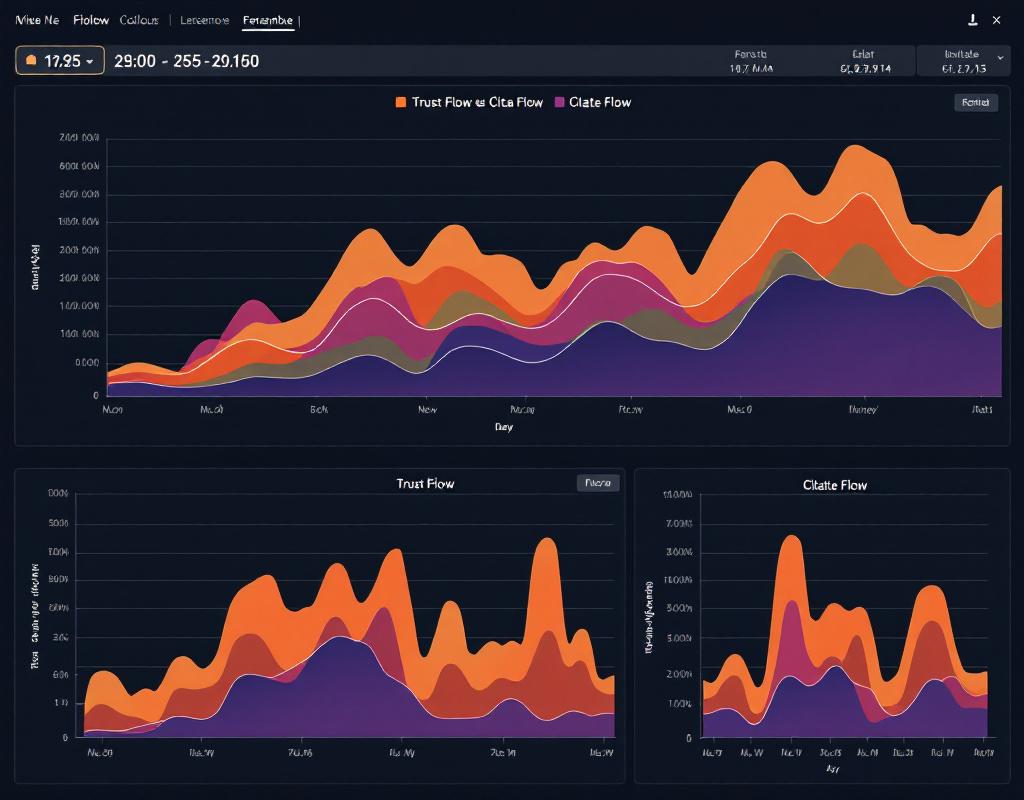
By comparing this data to your semantic universe, you measure not only the quantity of links but also their real impact. Sometimes a single link from an academic site with a Trust Flow above 70 brings you more value than dozens of backlinks from amateur blogs.
Techniques to optimize Trust Flow
There is no miracle recipe, but several proven methods allow you to gradually strengthen your trust score.
- Reference content: producing studies, white papers, or infographics naturally encourages sites to cite you.
- Targeted guest blogging: offer your expertise on reliable platforms, ensuring your author is associated with a solid biography.
- Quality partnerships: exchange links with sites that already have a high Trust Flow, adapted to your niche.
- Regular cleaning: disavow or remove toxic backlinks to avoid diluting your score.
- Monitoring new links: set up alerts to be informed as soon as a trusted site mentions you.
- Leverage advanced features of Majestic SEO to uncover unsuspected opportunities.
Over the months, these efforts create a synergy: the more trusted links you accumulate, the easier it becomes to secure new high-impact collaborations.
Monitoring and Reporting
Setting up a customized dashboard simplifies reading your progress. Monthly monitoring based on Trust Flow, Citation Flow, and the TF/CF ratio gives a precise idea of the evolution.
| Metric | Initial Goal | Target Value |
|---|---|---|
| Trust Flow | 25 | 35 and above |
| Citation Flow | 40 | 50 and above |
| TF/CF | 0.6 | ≥0.7 |
Tools like Google Data Studio or Excel can import your CSV exports and automatically update the charts. These reports can then be shared with the marketing team to align priorities.
FAQ
What is a good Trust Flow?
A score above 20 is often seen as satisfactory for a small organization, while 50 and above indicates a very strong profile, especially in competitive sectors.
Can you quickly increase your Trust Flow?
It is a gradual process. By acquiring a high-authority link, your Trust Flow can jump, but most of the time it takes several months of effort to see a significant increase.
Can Trust Flow decrease?
Yes: if trusted sites remove your links, or if you accumulate low-quality backlinks without disavowing them, your score can decline.
Are there alternatives to Majestic for measuring Trust Flow?
SEMrush and Ahrefs offer comparable metrics (Authority Score, Domain Rating), but the methodology differs. For a precise analysis of Trust Flow, Majestic remains the reference.
How often should you check your Trust Flow?
A monthly check is generally sufficient to track trends. In case of an intensive link-building campaign, weekly monitoring can prevent overlooking abuses.